SMS seventh-graders to become storytellers
Published 2:20 pm Thursday, October 2, 2008
SNOQUALMIE — Middle-school children have many
roles. Student, athlete, artist and friend are just a few. And soon,
12 Snoqualmie Middle School seventh-graders will have an
entirely new and important role — that of storyteller.
The storytelling program is a new innovation at the
middle school. It features students who applied to get into a class by
writing an essay and who have a desire to learn Snoqualmie Tribe
stories, then the students tell those stories to elementary classes.
The program was funded in part by the King County Landmarks and
Heritage and Arts in Education programs.
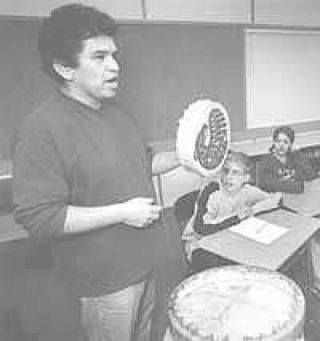
Last week, the young storytellers sat in a circle of desks,
listening to their principal and storytelling leader explain
the significance of the program.
“This is an important project,” Snoqualmie Middle School
Principal Jack McCullough told the students. “You are the first in
this project, and you should feel good about who you are and where
you are today.”
Lower Elwha Klallam tribal member, artist and teacher
Roger Fernandes will instruct the class, which will meet once a week for
the remainder of the school year. Fernandes was born and raised
in the Seattle area and has worked with many children in a
school setting, teaching them legends and stories of the native
people of Puget Sound. He knows by heart many Snoqualmie Tribe
stories.
“We’re going to be working on stories that have been
passed on from generation to generation,” he said, explaining the
importance of a tradition that involved no written words or paper.
“I feel that stories are meant to be shared,” Fernandes said.
“I feel like part of a chain with these stories, that people hundreds
of years ago told the same stories that I do today, and that
makes me feel good.”
The students will learn the correct Native American
pronunciation of Snoqualmie and other words and will make masks,
costumes and other tools to help tell their stories, such as “How
Raven Lost His Venison,” “Spring Salmon and Steelhead
Salmon,” and “Origin of Tolt River.”
The stories come from Fernandes’ memory, and are also in a
book called “Mythology of South Puget Sound.”
Once the students have mastered a few legends, which
should be in April, they will travel to elementary schools in
the Snoqualmie Valley School District and present the tales to
younger children.
“When they go to the elementary schools to tell the stories,
they will also leave the stories,” McCullough said. “This isn’t
just a one-shot deal, this is an integrated element of the
curriculum.” The plan is for the elementary
students to learn and appreciate the stories, with some of them
going on to be storytellers themselves.
The storytelling is an extension of the seventh-grade
studies of Washington State and Pacific Rim countries. Native
American studies currently are taught in seventh-grade social studies,
literature, language arts and art classes.
In addition to the curriculum, much of the school’s
remodeling was done with consideration to tribal patterns, colors and
designs. For instance, the entryway looks like a longhouse, which was
a type of structure Native Americans used as a meeting place,
and basket patterns are “woven” in the floor tiles along hallways and
in the commons area.
The reason for studying the Tribe’s stories and culture is
because the middle school sits on tribal land, McCullough
said, adding that since the community is changing and new residents
are moving in, Valley children don’t know the area’s heritage as
well as older residents.
“My feeling was we need to work with the kids as the
tribe worked with their children, which was storytelling,”
McCullough said. He added that teaching the Snoqualmie Tribe’s stories
will also teach a different perspective on land, history and progress.
“Progress sometimes tramples heritage,” he said. “We want
to teach them to think: `How can you find that balance between
history, heritage and progress?’ On every issue there’s a different
perspective, and if there’s anything that we teach them, we want them
to understand that every issue has different perspectives and
points of view.”
Fernandes said he is pleased that the school is
implementing the program and the students are showing an interest in their
land’s history.
“I think that they want to be respectful of the namesake of
the school, and to understand the complete history of this
area makes kids more connected with it,” Fernandes said.
In the future, students will carve a house pole, which was
traditionally placed outside one’s door to identify the family
living inside, but this house poll will tell of the middle school. When
finished, the pole will be placed at the entrance. A first- or
second-growth cedar was donated for the pole, and the Snoqualmie
Tribe is in the process of selecting a carver to work with the students.