Seed exchange grows at Fall City’s Masonic Hall
Published 7:00 am Thursday, February 19, 2015
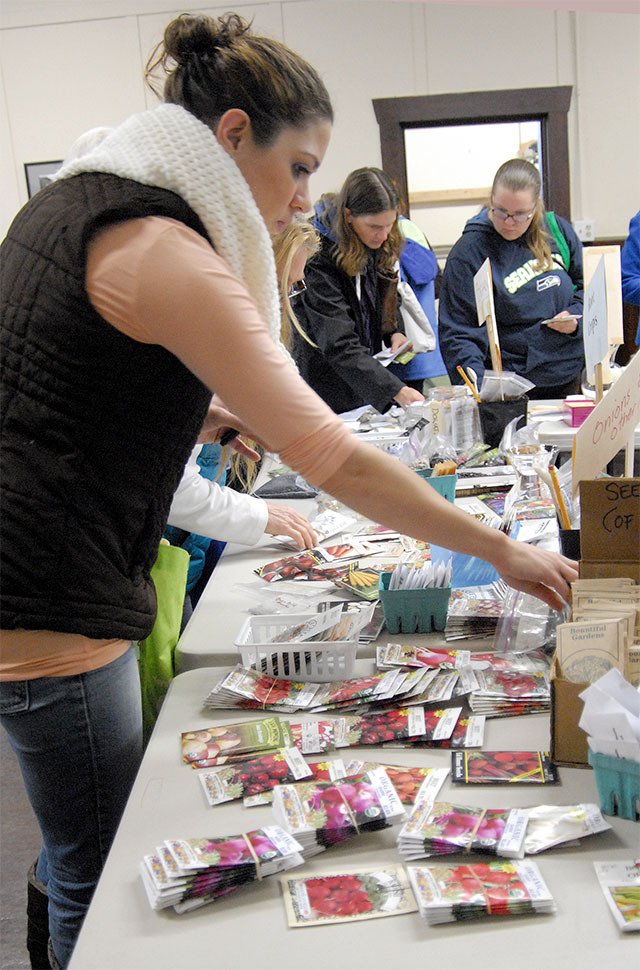
About 100 people are already packed into the Fall City Masonic Hall just before 11 a.m., and a few hundred more are expected within minutes, when Jessica Zielinski makes a discovery.
It’s a small but bulging envelope, stuffed with a variety of vegetable seeds – peas and corn, squashes and greens – and the label reads “Seeds for Kids (of all ages!)”.
“Oh, this will be FUN!” she says, reading through the planting instructions from Bountiful Gardens.
Zielinski lives in Maple Valley, but made the morning drive to Fall City, specifically for the seed exchange – making sure to arrive early. “There’s nothing (like this) in Maple Valley,” she said. “This is my fifth year. My sister and I come every year.”
Although it is a local event, the seed exchange, draws its audience from the Puget Sound area and beyond.
“We have people from all over, including Seattle – I just went to their seed exchange,” says Darien Payne, a Transition Snoqualmie Valley member who helps make the seed exchange happen. This year, several members of the Salish Seed Co-Op, a Whatcom County group with a seed exchange for the past seven years, attended the Snoqualmie Valley event, too, not to compete, but to support.
“It’s kind of related to the local food movement,” explained Payne. The Snoqualmie Valley Seed Exchange focuses on sustainable food growing practices, and seed with no genetic modifications (non-GMO).
“The GMO- and the hybrid seeds are… not designed for a local climate, or even, in the past, for nutrition,” Payne added.
As a by-product of that effort, it also keeps heirloom varieties of many vegetables growing – and a few that aren’t heirlooms, just unfamiliar.
Susan Gronlund of Fall City, caused a buzz with her exhibit of golden, knobby Jerusalem artichokes or sunchokes. She spent the whole event explaining how they grew, and how they tasted.
“I’ve been taking them to folk dances,” she said, “and people come up to me and say ‘I know what these are!’”
That’s pretty much how conversations started all day at the seed exchange, where information was in almost as much demand as seeds. At one table, a seed steward was pulled into conversation about growing tomatoes when she mentioned that she never had problems with hers.
Across the room, Tilth volunteer Julie Edwards speculated on a winter sowing exhibit with people, and two booths down, Susan Alling announced that the book “Heirloom Life Gardener” at the King County Library table, was “the best book! It’s like bed-time reading.”
Minutes later, Alling had to bang two pots together to be heard above the din, to announce that the first presentation of the day on saving seeds had begun.
“We’re here all day, and there are plenty of seeds,” she assured the group, some of them obviously reluctant to leave the swap until they had found what they wanted.
Last year’s event, at the Sno-Valley Senior Center in Carnation, drew about 300 people, Payne estimated. The event was located there because “we knew we needed a bigger space,” but even with sponsorships and a grant from King County 4Culture, she said, they barely broke even. So this year, The event returned to Fall City, but took over the second story, too, for presentations.
Organizers are committed to keeping the event all volunteer, and offered incentives to people who volunteered at the event this year.
To learn more visit http://www.snoqualmievalleyseedexchange.org.
The Snoqualmie Valley Seed Exchange was sponsored by Sno-Valley Tilth, Transition Snoqualmie Valley and Strategies for Provident Living, with a grant from 4Culture.

Susan Alling talks gardening books with Irene Wickstrom of the North Bend Library.

Carnation boy Stephen, age 4, picks out some seeds for himself while visiting the seed exchange with his parents.

Sno-Valley Tilth volunteer and North Bend resident Julie Edwards, left, packages up some seeds as the seed exchange is about to open to the public.

Liz Schwartz, gardening expert from Duvall True Value, talks about starting seeds with a visitor.

Susan Gronlund talks sunchokes with a volunteer at the seed exchange.