Dunn, Murray take field trip through forest
Published 1:43 pm Thursday, October 2, 2008
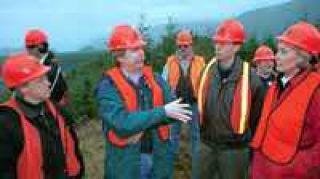
SNOQUALMIE – Atop an overlook in the Snoqualmie Tree Farm, it becomes apparent how massive the deal to conserve its 104,000 acres is.
From the south, where it borders the cities of Snoqualmie and North Bend, to the north, which eventually disappears amidst the rain and low-lying clouds, stretches the tree farm. The land slopes up and down between lakes, rivers and streams, with Fuller Mountain acting as a sentry to what’s been called the “jewel” of east King County.
It is from this vantage point that Evergreen Forest Trust rallied support for its deal to purchase 99,000 acres of the Snoqualmie Tree Farm from its owner, Weyerhaeuser Co., last Friday, Feb. 22. The deal would effectively block sprawl from encroaching on northeastern King County.
On hand for the event were two women who will play an important role in ensuring the agreement goes through, Sen. Patty Murray and Rep. Jennifer Dunn.
The Washington legislators are working to push a bill through Congress, allowing Evergreen Forest Trust to use tax-exempt revenue bonds to purchase the tree farm from Weyerhaeuser for $185 million.
“I think what we’re seeing today is the power of a good idea,” Dunn said.
Murray said the proposed $185 million purchase shows that preserving forestland while continuing to harvest timber on it are not mutually exclusive ideas. Evergreen Forest Trust would harvest trees to pay off the bond debt.
“It is truly, I think … a milestone of how we can do working forests that have conservation as well,” she said.
Murray first introduced the Community Forestry and Agriculture Conservation Act two years ago, with Dunn sponsoring the legislation in the House of Representatives last year. The act seeks to amend the Internal Revenue Service code so nonprofit organizations could obtain tax-exempt revenue bonds for purchasing forest and agricultural lands.
The act requires that those lands should have a “conservation restriction,” and nonprofit groups must create a plan to manage them.
Under the deal announced in January by Evergreen Forest Trust and Weyerhaeuser, the Cascade Land Conservancy will hold the conservation easement for the Snoqualmie Tree Farm, which would be renamed the Evergreen Forest at Snoqualmie. The land conservancy group also helped the city of Snoqualmie, King County, Puget Western Inc. and Weyerhaeuser ink last year’s Snoqualmie Preservation Initiative.
Portland-based forest management company The Campbell Group would create a five-year management plan for the Snoqualmie Tree Farm with input from Evergreen Forest Trust’s board of directors. The Campbell Group hopes to have the management plan finalized by the end of the year, assuming financing for the agreement is approved.
However, even if Congress acts on the legislation this year, it would be too late for the Snoqualmie Tree Farm purchase-and-sale agreement.
That’s why Evergreen Forest Trust is seeking a waiver from the IRS, which would allow the deal to go through even without the legislation, explained forest trust board member Rob McKenna, a Metropolitan King County Council member from Bellevue.
Dunn said she would meet with Bush administration officials on Wednesday, Feb. 27, to discuss the IRS waiver and the proposed legislation.
“That’s the kind of project [President Bush] would support,” she said.
About 20 percent of the 99,000 acres – Weyerhaeuser would retain the surface and mineral rights to the remaining 5,000 acres of the Snoqualmie Tree Farm – would be set aside for conservation and not be harvested, said Charley Bingham, a former executive vice president with Weyerhaeuser. He said to pay off the bond debt, Evergreen Forest Trust would harvest about 2 to 3 percent of the tree farm each year.
“We’re going to replant every acre we cut, and we’re going to keep it growing,” said Bingham, an Evergreen Forest Trust board member.
He acknowledged there would be tension among board members on how much to harvest and how to manage the land. For example, as the bond debt is paid off, land could be taken out of production, or it could be harvested to raise money for future purchases.
Charlie Raines of the Cascade Land Conservancy said environmentalists would rather see the land logged than developed.
“I think most of the people I’ve talked to see the glass as half full, [instead of] as half empty,” he said.
Dunn agreed that compromises had to be made to protect the land, saying, “Everybody is giving up a little to get a lot out of this.”
You can reach Barry Rochford at (425) 888-2311, or e-mail him at barry.rochford@
valleyrecord.com.