More houses, more cars: North Bend candidates discuss city’s growing pains in candidate forum
Published 5:03 pm Wednesday, October 14, 2015
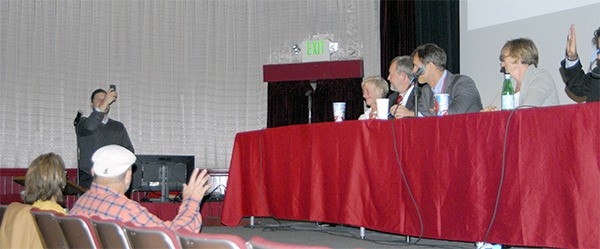
Growth and its accompanying strain on traffic, city infrastructure and the existing city residents continues to be the biggest issue for candidates for North Bend City Council. The incumbent and aspiring city councilors gathered at the Oct. 7 Snoqualmie Valley Chamber of Commerce-sponsored candidate forum at the North Bend Theater, discussed the challenges of growth for several hours that evening, each emphasizing his or her own take on the issues.
Mary Miller, write-in candidate for mayor, talked about her passion for the people in the community, and her desire to represent them in city government.
Mayor Ken Hearing, running for his fourth term, talked about his leadership through the city’s long history of slow growth or none at all, and wins the city has had in dealing with past and future growth.
Martin Volken, running for Position 7 talked about good governance, and what was needed to keep North Bend the “cool” place that had attracted him, and many others to live there, as people continue to move into the city.
Judy Bilanko, opposing Volken at Position 7, said “I love North Bend for what it is,” adding that she wanted to make sure the city maintained its charm and independence.
Brenden Elwood, running for Position 5, emphasized slowing the pace of growth, to ensure that all of the city’s residents had a voice in planning for growth “if that’s where we need to go.”
David Cook, who currently holds Position 5, focused his talk on what the city is doing to address those problems now, and the complexity of the issues facing the city council. He also praised the current city council for its democratic and collaborative processes.
Trevor Kostanich, running for Position 3 against the absent Councilman Dee Williamson, put forth ideas on limiting the city’s required growth to areas that are already being developed, to improve the trail connectivity in the city and to “front-load” funding for infrastructure expansion to support that development. He also echoed statements made by Miller and Bilanko about being eager to learn more about how the city funtions.
Jonathan Rosen, incumbent councilman at Position 1 is unopposed and did not answer questions during the forum. In his opening and closing statements, though, he noted the city’s many accomplishments, including the acquisition of water rights that ended a 10-year building moratorium, a new cottage housing development and the transition made last year to a police contract with Snoqualmie.
Moderator Steve Pennington directed questions at the candidates, and attempted, with little success, to limit them to the one- or two-minute answer times allotted to each. Following several rounds of one-minute questions, he told the candidates that they would each have two minutes for the next questions, “although you’ve all done a good job of two-minute answers already!”
Many of the candidates agreed in their answers.
A question on their support for a hypothetical expansion of the city’s Urban Growth Area for potential future annexations was resoundingly rejected by all but one person at the table. Development could be kept within the city’s current limits, they said, expansion isn’t needed, but downtown revitalization is.
Only Hearing differed. “What if it was good for the city?” he asked, then described a potential scenario in which the city could “trade” for open space in one area by allowing development in another. He added, though, that the city would have to purchase any property it acquired as open space.
A question on transportation improvements produced similar consensus. Most candidates agreed that the city needed to pursue funding sources, such as traffic impact fees and grants to build the traffic infrastructure needed to support the new residents and their cars.
Hearing expounded on the difficulties of spending money in advance of growth, noting that any projects done before development starts are removed from the city’s six-year traffic improvement plan, which is used to calculate the traffic impact fee; if a project is done, it’s taken off the list, leaving the city’s existing tax payers to fund it.
Volken also expanded on this question, which he felt was at the heart of residents’ perceived frustration with growth. “There’s not that many people,” he said. “It’s the cars.” While the city does need to pursue outside funding for traffic improvements, he said, “I would also love for people to leave their cars at home.”
Other questions included:
How to reach out to the public and assess community support – Most agreed that it took a multi-faceted approach that included social media and news outlets. Miller, Elwood and Cook expressed a preference for personal contact with members of the public, as well;
Affordable housing – Most candidates agreed the demand was greater than the supply, and that it was a complex issue, tied closely with density. Bilanko noted that the city is anticipating more than 100 units of housing, in apartments and cottage homes, that will help to address the shortcoming, although Cook pointed out that at a recent affordable housing forum held in North Bend, real estate agents projected a need for more than 5,000 units of affordable housing in the Valley.
Water and sewer needs – Again, most candidates agreed that the city’s future water needs were fairly well-resolved and that something needed to be done about the city’s aging wastewater treatment plant. Several also brought up the need to move the remaining neighborhoods within the city that are on septic systems onto the sewer system;
A bond, to increase taxes, for downtown revitalization – Support was broad, but for different reasons and under different conditions. Miller and Volken commented on the real need for improvements downtown to support existing businesses. Volken, a downtown business owner, said he’s had run-down buildings around his North Bend Way business for decades, and “I don’t think that’s a way to govern… I would support a bond to acquire and tear down (such) properties. I think we can do better than that.”
Hearing, Bilanko, Cook and Kostanich expressed support for a bond to build up downtown, not just to remove blight. Projects they supported included the planned downtown plaza and a new city hall.
“I’m in favor of the right bond, for the right project,” Cook said, adding that he hoped, “when the council changes in 2016, that conversation will start.”
Elwood liked the idea of taking the bond to the voters for approval, but, like Bilanko, doubted that it would pass in the current voting environment.
Several candidates also commented on the moral dilemma in condemning private property for downtown improvements.
Ballots are scheduled to be mailed this week for the Nov. 3 general election. All ballots must be marked and returned by midnight on Nov. 3 to be counted. For more information on the general election, visit www.kingcounty.gov/elections.
The Snoqualmie Valley Chamber of Commerce hosts another candidate forum, featuring candidates for Snoqualmie Valley Hospital Commission and Si View Parks District, Friday, Oct. 18, at its monthly members luncheon. Register to attend at www.snovalley.org.

Martin Volken, right, with Mayor Ken Hearing in the background, talks about how to improve North Bend’s traffic problems in the Oct. 7 city council candidate forum at the North Bend Theater. Volken is running for Position 7 on the city council. His opponent is Judy Bilanko.

Brenden Elwood, far right, answers a question during the Oct. 7 candidate forum at North Bend Theater, along with candidates, from right, Judy Bilanko, Martin Volken, Ken Hearing and Mary Miller.

North Bend City Councilman David Cook takes a question during the Oct. 7 candidate forum.