Fighting for her life
Published 2:08 pm Thursday, October 2, 2008
The small town of North Bend is well-known for its unique character, a place of great beauty populated by a caring community. Nestled snugly against the Cascades, stunning mountain views and clean, fast-flowing waters are a part of everyday life here that few take for granted. A perfect setting, some might say, for the quiet miracle that has drawn nearly 100 people to a small farm at the heel of a dead-end road.
The farm is Elk Run Stables, home to more than a dozen horses highly trained in the art of dressage – the graceful, equine ballet most often associated with the famous Lipizan stallions of Austria. It is there, in an oversized stall that opens to the riding arena, that a tiny foal battles for life against incredible odds.
The filly, still unnamed, was born April 30, several weeks premature. With underdeveloped respiratory, vascular and muscular systems, she had almost no chance for survival. Too weak to stand or nurse, even feedings through a stomach tube and round-the-clock care by a team of dedicated veterinarians at Snohomish’s Pilchuck Equine Hospital appeared futile. After four days of intensive, expert care, and with expenses mounting, the foal was sent home to Elk Run to spend her final hours.
“It is very rare for a foal born so early to live even in the best intensive-care setting,” said Larry Pickering, a Woodinville veterinarian and equine specialist who has cared for the filly since her untimely birth. “But nobody thought she could survive outside the hospital. That she has made it this long is a tribute to the magnificent teamwork of a large group of very dedicated volunteers. It’s very impressive, and it’s made the total difference.”
The filly’s owner, 29-year-old Paige Ruhl, is a skilled horse trainer and riding instructor at Elk Run Stables who often competes with horses belonging to others. With the cost of a competitive dressage horse beginning at about $35,000 and running as high as several hundred thousand dollars, it was not until two years ago that Ruhl was able to realize her dream and buy her own thoroughbred mare, Kali.
But luck was not with Ruhl. No sooner had she begun competing with Kali than the mare developed ethmoid hematoma, a painful condition that ended the magnificent animal’s short career. Disappointed, but by no means defeated, Ruhl set out to breed and train her own competitive dressage horse.
She spent the better part of a year searching for the perfect stallion to mate with Kali, and finally settled on Walldorf, a Hanoverian imported from Germany to North Carolina in 1995 and sire of an Olympic champion. Kali was bred successfully, but Ruhl’s joy quickly turned to alarm when a slight placental infection sent the mare into labor two months early.
“This baby was supposed to die in February,” Pickering said. “We were able to stop the labor and keep the foal on board for seven more weeks, but she was still born much too early.”
As soon as word got around, friends, family, neighbors, stable employees and even strangers surrounded Ruhl, offering support and donating supplies. In an effort spearheaded by Elk Run Stables owner Barb Ketzel, 10 volunteers worked nonstop for 18 hours to convert two stalls at the stable into one large neonatal intensive-care unit.
“We did this for the love of Paige,” Ketzel said. “We have watched her work so hard for so many years. We have watched as she has developed into an exceptional woman with such extraordinary skill.
“This has been a lifelong dream for Paige. When Kali started to abort and then foaled prematurely, we all felt the injustice. Everybody has fought so hard for Paige and this foal because for so many years we have watched Paige struggle to realize her goals and dreams, and this filly is amazing. She refused to die.”
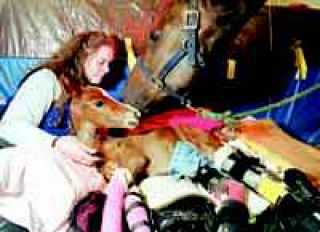
The tiny foal lays on a bed of camping mattresses, further softened by multiple layers of foam. Gym mats line the wall, held securely with duct tape. A “memory foam” pillow supports the filly’s head, while baby blankets and an overhead heat lamp keep her warm.
At three weeks old, she weighs just 52 pounds – about half the weight of a full-term foal at birth.
Just two weeks ago, it appeared all hope was lost. The foal could no longer take the force feedings through her stomach tube, and she failed to thrive. Grief stricken, Ruhl called Pickering to come out and end the misery. A grave had already been dug behind the stable.
“It was a beautiful, sunny day,” Ruhl said. “I wanted her to see the sun.”
Surrounded by friends, she carried the filly outside, laying her on the grass near the grave. It was two hours before the veterinarian could get to Elk Run. As he drove up the road, Ruhl tried to give comfort and put a bottle to the filly’s mouth. Somehow she found the strength to nurse, and for the first time, she finished a feeding.
“I almost never decide to change course once a decision has been made,” Pickering said. “People have already begun to let go, begun the grieving process. But in this case, it was just so amazing. She finished that whole bottle and maybe there was some hope, even if it was slim. We picked her up and carried her back into the barn.”
The oxygen and feeding tube that ran from her nose to her stomach have now been removed, but on her forelegs Ace bandages are tightly wrapped from hoof to torso. To the rear, full-leg braces of steel and Velcro ensure that her joints, not yet fully mineralized, will not crush under her own weight. A needle protrudes from her jugular vein, allowing access for her frequent medications.
Kali keeps watch, pacing the stall as mother and daughter exchange soft nickers. Protective of her foal, Kali will not allow dogs, chickens or other horses near the filly. But she is tolerant of the constant human presence, allowing herself to be milked several times a day so the foal can be nourished on her mother’s milk from a bottle.
At least two people, and often more, stay with Kali and her foal 24 hours a day. There are feedings to take care of, medications to give. The filly must be turned to reduce the bedsores that form so easily, and care must be taken to make sure that Kali does not accidentally step on her foal. A camper has been backed up to the barn, a place where the humans can catch a catnap in shifts.
That this foal is alive defies all expectations, but the miracle involves more than survival. She has been the catalyst for something much larger, a transcendence of the spirit. For all those involved, she has provided a focus where the nobility of life – human and horse – has emerged to display the best in both. Courage, determination, love and hope are the common bond.
“Every day people just put their hearts into this,” Ketzel said. “There are about 80 people helping in one way or another. Students, employees, friends and neighbors – even some with horse allergies that can’t come in the barn. They’ve just given their hearts to Paige and to this foal.”
The effort has not come cheap. Ruhl tapped all her resources, spending $10,000 in the first two weeks after the filly was born. Elk Run Stables went in the red about $8,000 between financial assistance and lost income when lessons had to be canceled to allow Ruhl and Ketzel to care for the foal. Even with all the donations of time, food and supplies, many thousands more dollars will be needed to pay the medical expenses accumulated to date.
Was it worth it? Pickering says a resounding “yes.” He is now much more confident the foal will survive, despite the uneven odds. Evidence suggests that she will catch up in size and weight eventually. Time will tell if orthopedic problems arise.
But Pickering, Ruhl, Ketzel and almost 100 others believe this life has a purpose, and this filly allowed them something most rare.
“It’s just amazing,” Ruhl concluded. “I thought this foal would be born healthy or dead, not in between. If she makes it, I’m not sure she’ll be the competition horse that I’ve always dreamed of. I don’t dare to hope that much. But the support of this barn and all these people for this filly – she just won’t let us stop.
“She wants to