Growth district: Enrollment continue to climb, drives need for new facilities
Published 4:44 pm Wednesday, January 14, 2015
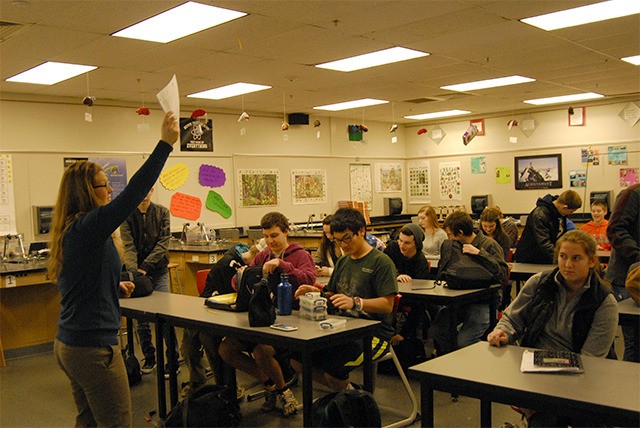
It’s a busy day in the computer lab off Mount Si High School’s library. Teens work at each of the 17 computers, and teacher Bev Weller moves between students as they ask for help. Some are doing their end-of-semester tests, but the room, which is also the Snoqualmie Valley Virtual Academy space for online students, is always full.
“Come on in,” Weller says. “We’re in a closet!”
Although it’s an extreme example of crowded classrooms, the computer lab highlights some of the problems that Mount Si High School Principal John Belcher is struggling with, and why the Snoqualmie Valley School District has proposed a $244 million bond to rebuild the high school, as well as a new elementary school, restore a third middle school and repair every other school in the district, over the next eight years.
“The rooms are a little small, and students can’t do what we call elbow talks,” Belcher said, on a preview of the public high school tours set for 7 p.m. Thursday, Jan. 15 and Wednesday, Jan. 21.
The rooms and the furniture inside, are also not the flexible workspaces that more modern schools provide. In working with the high school vision committee of students, staff and parents, Belcher said they agreed on the need to introduce more opportunities for collaboration, for both students and teachers.
“We don’t want to go back to departments in silos,” he said. Instead, he and vision committee members would propose shared teacher workspaces, enabling staff to collaborate more easily and build lessons on a unifying theme
Small classrooms, inflexible workspaces, and a few other quirks like a stage ceiling that’s a third of the ideal height, are all challenges to Belcher, but a failing building is not a challenge, he said.
“Our current building is not in disrepair,” he said. “We work really hard at maintaining the facility we have.”
The 1,600-student-capacity main campus, built in 1953, is, for the most part, seismically sound, too. A structural engineer who reviewed the facilities for stability made a few recommendations for improving the building, but none were urgent, or significant.
What Mount Si isn’t, is large enough for the projected growth, say school officials.
“We are a growth district,” says Superintendent Joel Aune.
Snoqualmie Valley is expected to grow at an average rate of nearly 2 percent annually, through 2020, and at a slightly lower rate through 2034, according to district demographer Les Kendrick. He presented his student forecast numbers to the board in October, and cautioned them that the more distant the date of the projection, the less reliable the data may be. He was however, confident of the projections through 2020.
By that year, he forecast that the district would have 2,042 full-time equivalent (FTE) high school students, 1,766 middle school FTEs and 3,271 elementary FTEs. Further, he said, two different calculation methods predicted 7,300 FTE students at the district by 2020. As of the district’s December enrollment report, there were 1,720 FTEs at the high school, 1,506 at the middle school and 2,926 at the elementary schools. Total FTE population was 6,001.
Some of the reasons for the district’s steady growth, Kendrick said, included that all of King County is growing — student population jumps about 4,000 annually, for example — and Snoqualmie Valley’s share of the population, both students and general, is growing, too. This school year, Snoqualmie Valley’s share of the county’s student population is 2.4 percent, up from the 2.3 percent of the past several years.
Countywide, a drop in real estate prices that began in 2007 is also driving growth, Kendrick reported. Although the district has averaged 200 home sales per year since 2010, he told the board that the district had more than 200 sales by September of this school year.
Using city planners’ data from North Bend and Snoqualmie, Kendrick was also able to project 2,100 new homes to be built in the district by 2020. About 800 of them have already been permitted. These new homes could increase enrollment by 911 students by 2020.
These growth projections have been a significant part of the Snoqualmie Valley School Board’s deliberations since the 2011 failure of two bond issues that would have built a third middle school in time for Snoqualmie Middle School to be annexed as the high school’s freshman campus. In December 2012, the board began discussion of possible bond issues, and by May 2013, they had developed three options for the community’s considerations.
Public meetings began in May and in July, the board voted to pursue the scenario known as Option A (essentially this February’s bond) by “vetting” it with the public and staff.
One of the first concerns raised, based on the enrollment projections, was that the high school would be full when it opened, a possibility Kendrick pointed out in last year’s enrollment projection report. The board opted to base their bond research on Kendrick’s low-range numbers, rather than his recommended mid-range numbers, and were criticized for that.
This year, the board has accepted the mid-range projections, and adjusted the bond proposal to have a slightly larger high school capacity, from 2,100 to 2,300 students.

A “closet” of a computer room just off the library at Mount Si High School is filled with students taking online courses. Students will also use the computers for upcoming standardized testing.
Bond details
Total cost, $244.4 million
Includes: Sixth elementary school, open by September 2016, restoration of Snoqualmie Middle School, phased demolition and rebuild of Mount Si High School.
Estimated bond tax rate: $129 per $100,000 of assessed value, or $516 for a $400,000 property.
Deadline for new voters to register: Feb. 2
Ballots mailed: Week of Jan. 19
Election day: Feb. 10