Road work ahead: County task force presents recommendations for huge maintenance funding gap
Published 12:26 pm Friday, January 22, 2016
Roads and bridges throughout King County are deteriorating faster than the county’s Road Services staff and an annual $100 million in revenue can maintain them. Proper upkeep of the county’s transportation infrastructure will require almost four times that amount by county estimates, and even more by business consulting firm BERK Consulting’s calculations.
Spending $100 million annually, according to the consultant’s report to an advisory Bridges and Roads Task Force formed in 2015, is not enough. BERK forecast that the county would have to close 35 of its 181 bridges and 72 of its 1,500 miles of roads in the next 25 years if current funding levels persisted.
The problem is the product of almost 30 years of the county losing its tax base to city annexations, declining gas tax revenues and revenue-limiting voter initiatives, say county officials.
“And of course the way infrastructure works, if you don’t do the proper maintenance now… it’s going to turn into a far more expensive project down the road,” said Snoqualmie Mayor Matt Larson.
A member of the 21-person bridges and roads task force created last year to propose solutions for the roads funding problem, Larson helped present the results of the group’s work to King County Executive Dow Constantine and County Councilmember Kathy Lambert on Wednesday, Jan. 20.
Taxes, tolls and a fee for miles driven were all suggested by task force members, in an effort to find what Larson described as “some sort of proportional mechanism for taxing by county and city.”
The group also focused on reducing the overall roads liability, through changes to legislation on roads maintenance standards, giving little-used roads to private owners or requiring cities to annex “orphaned” county roads within city limits.
All of the proposals would require support from the county’s 39 cities and other jurisdictions operating in King County.
Larson, whose city is roughly halfway through a $60 million downtown corridor renovation (started in 2010), said many cities are also struggling with their own infrastructure costs already.
“They’re not real warm to the idea of going out there and helping the county solve their problem,” he said, adding that “it’s important in the next steps to engage the cities, because they’ll have the revenue for infrastructure because they have the retail and commercial properties.”
The task force had recommendations for engagement and outreach, as well as revenue generation, operations efficiency and infrastructure.
“Ideas ranged from proposing new ways of handing over roads from King County to private citizens or cities, to applying for new grants, contemplating what to do about diminishing gas taxes and considering citizen based ‘crowd funding,’” task force member Ashley Glennon of Fall City wrote in an e-mail message to the Record about how the task force got to work.
Glennon and Janet Keller, also of Fall City, represented the unincorporated communities of King County on the task force.
After initial rounds of idea generation, Glennon wrote, “We applied various filters such as ‘How big a revenue impact might this idea have? What might be the social justice implications? How realistic is the idea? How complicated is the idea?’”
More than 150 proposals from the group were fine-tuned to about two dozen possibilities recommended at the Wednesday presentation, including:
- Outlaw studded tires;
- Renegotiate contracts with maintenance worker unions;
- Petition the legislature to allow the county to bypass the 1 percent increase limit on tax revenues;
- Petition the legislature to allow the county to sell or give little-used roads to the property owners who use them;
- Increase inspection on new developments to ensure roads standards are met;
- Consider mass transportation, pedestrian and bicyclist needs along with roads needs, to limit individual car trips and increase bus or rail ridership and foot traffic;
- Work with cities and neighboring counties on transferring properties or sharing maintenance responsibilities;
- Invest in unincorporated commercial areas to increase commercial tax revenue;
- Implement a user fee, such as for miles driven;
- Implement a sin tax, utility tax or increased gas tax for roads;
- Toll roads;
- Create a new lottery for roads funding;
- Crowdfunding; and
- A countywide outreach campaign encouraging the use of alternative transportation.
Constantine is expected to review the recommendations in the coming months and to make a recommendation to the full King County Council later this year, prior to approaching the state legislature about possible solutions.
“Providing safe and reliable roads is a top priority, and in continued partnership with the cities we will again look to the legislature for solutions that work for the 21st century,” said Constantine.
“These recommendations reinforce the urgency of the need, and provide new ideas for keeping communities connected.”
Learn more about the King County Bridges and Roads Task Force at www.kingcounty.gov/depts/transportation/roads/roads-task-force.aspx.

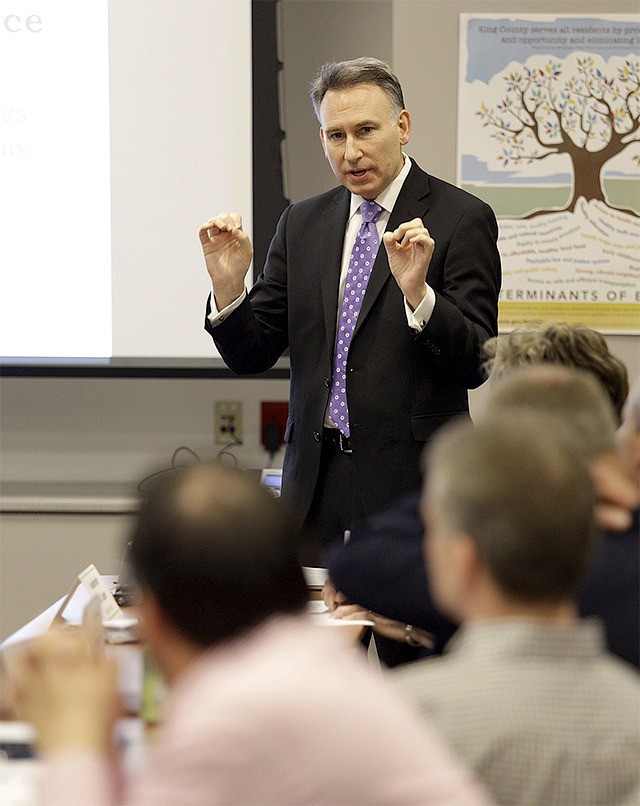
Mayor Matt Larson presented recommendations from the Bridges and Roads Task Force to Executive Dow Constantine and County Councilwoman Kathy Lambert Wednesday.