From silent to sound: A history of movie theaters in the Valley
Published 11:33 am Thursday, October 22, 2015
The Snoqualmie Valley has always had a historic connection to the movies. From the era of the silent film to today’s modern era, the local theaters have always played an important part in the Valley.
Due to the collection of Valley history in the Snoqualmie Valley Historical Museum and the hard work and research of David Battey, recording secretary for the museum board, the history of these theaters has been preserved. Almost all the information available on these theaters was recorded by Battey.
Battey has written several articles about the history of the Valley’s theaters since the early 1900s. The Valley had three major theaters: the Sunset Theater, the Pictureland Theater, and Brook Theater.
Cristy Lake, assistant director at the Snoqualmie Valley Historical Museum, said the Sunset Theater was built into an existing Snoqualmie building that is now Sigillo Cellars in Snoqualmie.
“The Sunset Theater is still around,” Lake said. “It was repurposed as a town hall and fire hall, then it was the union hall for years, and then Christine purchased it and restored it as Mignone and then it’s been several business since then.”
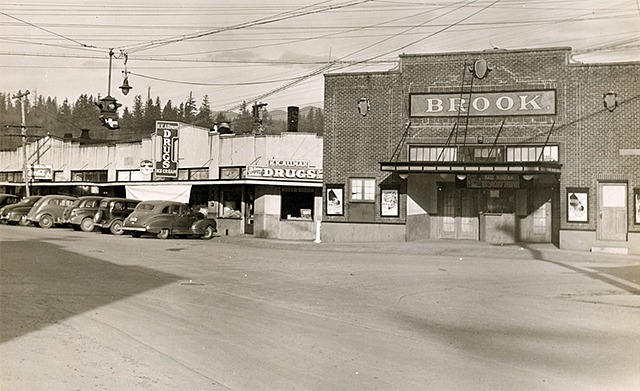
In 1923, the Brook Theater, built by William and Geneva Cochrane on the Northeast corner of Meadowbrook Way and Park Street in Snoqualmie, opened.
The Brook was the largest and most luxurious of the theaters in the area. It could seat over 400 people, had cushioned seats and the newest movie screens and projection technology. Over $20,000 (roughly $280,000 in 2015 value) was put into the building’s development.
These theaters showed the latest silent movies with live music accompaniments by a pianist and a violinist.
According to Battey, E.W. Sandell, the owner of both the Sunset and Pictureland theaters, sold both theaters to the Cochranes in late 1923 due to the huge competition the Brook had brought to the Valley.
“The guy that started the two silent movies before the Brook, he just kinda disappeared back to Issaquah and then the Brook folks bought him out. So they had all three,” Battey said.
In the late 1920s, sound was introduced to the world of movies. The two competing technologies, the Vitaphone and Movietone systems, were both installed in the Brook so the selection of movies wasn’t cut off. Battey described these systems as reminiscent to format wars we have seen in the last couple decades.
“It is kind of fun when they started the talkies. It was like VHS vs Beta,” He said. “There were two ways to show talkies and they had to pay to have both of those systems installed in the Brook Theater.”
The Brook saw a lot of success when it started showing “talkies,” but this new technology made the Sunset and Pictureland theaters largely irrelevant as they were still limited to silent films. Due to the recession, which started in 1929, both theaters were closed in 1930 so the Cochranes could focus on the Brook Theater.
Battey gathered much of his information from Cochranes’ corporate records for his research into the business behind the theaters in the 20s.
“If you are going to waste money when you have none, a movie ticket is an absolute wonderful indicator of how much spare change there was in the Valley, so I thought that was amazing to find all of the corporate books of the Cochrane Motion Pictures Corporation, including the closing down of Pictureland and Sunset and the beginnings of Brook, all there,” Battey said. “It was just amazing.”
The Cochranes ran the Brook Theater until the 1940s when they sold it. The theater eventually closed its doors in the 1960s.
But that was not the end of movies in the Valley. In 1941, the North Bend Theater opened. It is still standing in the same spot and is still open for business.
Lake said having three theaters in such a close range to each other really showed how important that kind of entertainment was to people. The fact that the North Bend Theater is still standing and in good condition after 74 years is a testament to the hard work and passion the community has for the history of the Valley.
“I think it’s very cool we had three theaters in a relatively small community,” Lake said. “To me that shows it was a huge community draw that so many people were able to go and sustain three theaters. Of course the Depression hit and two of them closed, but I think it’s really significant that within two miles of each other there were three theaters. It’s really rare that there is a historic theater intact today and we are lucky to have that in our community.”

The Sunset Theater on what is now Railroad Avenue.

The North Bend Theater (or Cinema in this case) as it started in downtown North Bend in 1941.

William Cochrane poses for a picture with a moviegoer at the Brook Theater.