The hard questions: Candidates share their visions for ?two cities in Friday forum
Published 1:58 pm Wednesday, September 23, 2015
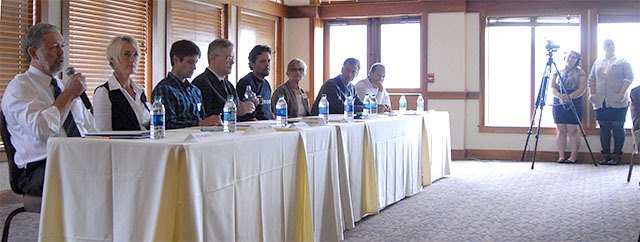
The Snoqualmie Valley Chamber of Commerce held a forum Sept. 18 at TPC at Snoqualmie Ridge for candidates in the upcoming elections to share their views on the important issues facing both their communities.
Snoqualmie candidates were incumbent Charles Peterson in position 6 and his opponent Joe Larson, and uncontested candidates, incumbent Chelley Patterson, position 2 and Brad Toft, position 4.
North Bend candidates were incumbent Mayor Ken Hearing and write-in opponent Mary Miller; Jonathan Rosen, unopposed in position 1; Trevor Kostanich and incumbent Dee Wayne Williamson, who coudn’t attend, for position three; incumbent David Cook and Brenden Elwood for position 5, and Judy Bilanko and Martin Volken for position 7.
Moderator Steve Pennington asked candidates questions, which they were given one minute to answer.
Over the next two weeks, the Record will present the questions and answers, featuring a few from each portion of the forum each week.
The Chamber will also host a candidate forum Oct. 7 at the North Bend Theatre, featuring candidates for North Bend City Council. For more information, visit www.snovalley.org.
Snoqualmie candidates took questions first.
What is the most critical issue facing Snoqualmie?
Peterson: One of the most critical issues is our revenue stream. We have a lot of infrastructure that needs to be repaired, our roads are starting to wear out and we have set aside money in the utility rates for the next three years to address all those needs… We have the revenue to be fiscally responsible to meet the needs of the city.
Larson: One of our biggest achievements in the last 12 years is the responsibility with which the leadership, council and staff, have been very judicious about managing our budget and anticipating future costs. That’s difficult when you have fluctuating revenues based on tax appraisals.
How would you fund infrastructure costs (police, roads) since development has slowed?
Larson: If the projections hold, the revenues we can gain from utility taxes should keep pace. We have opportunities through sales tax revenue as retail picks up in the downtown corridor. I’m confident we have two or three avenues to meet anticipated expenses.
Peterson: We have three funds, we set revenues aside each year to meet particular unseen needs or to pay off projects we’ve worked on… If the Muckleshoots do decide to build their hotel and housing, that would be the last development.
How might a planned full-service grocery store affect livability in Snoqualmie?
Peterson: We have leakage, we’ve done studies. Approximately 70 percent of the money people in Snoqualmie spend is (spent) before they get to Snoqualmie. If we can recapture some of those funds, that gives us additional sales tax to support the needs of the city. We will certainly make sure it doesn’t have drive through, but I look forward to it being a product (to meet) your needs and (provide) additional money to the city.
Larson: We are mindful of the negative impact on existing groceries and competing retail, but overall the benefits resulting from the increase in sales tax and the convenience of being able to run down to the Parkway versus all the way out to Issaquah or North Bend are huge.
Up next were candidates for North Bend Mayor and City Council.
What’s the most critical issue facing North Bend?
Miller: Traffic congestion, problems with infrastructure. It’s a place we want to have people come to.
Hearing: I have submitted to council a transportation impact plan which, if implemented and all development occurs, we could use that money to solve the majority of the issues that are facing us today.
Kostanich: We have an opportunity to be proactive about mobility. In addition to vehicular mobility, I’m a big proponent of improving our non-motorized mobility in North Bend… I’d love (for us to) as new developments come in, actually require neighborhoods to add that mobility link for a trail to get to an existing trail downtown, our businesses and schools.
Cook: The Growth Management Act in ‘91 wanted the city to grow by 5,000 homes, but the city negotiated down to 1,590. We are roughly halfway there. Between 2012 and 2031 we have to grow 649 more homes. We don’t have a choice, because the state will sue the city into oblivion and cut us off from funds and services. We have some solutions already in place to deal with growth and traffic.
Elwood: We have to make sure we are preserving and accentuating all that North Bend has to offer. We have fantastic outdoor resources and great people, but we are out of touch, not only with our citizens but with our local business owner. We have to have those two solid before we can even start thinking about what we can do with our community.
Bilanko: Traffic. I support the notion that growth needs to pay for growth, I support increased transportation impact fees so that we can deal with that growth. I don’t think any city can afford to fix everything without those fees or grants. I believe that will make everyone a little more comfortable with the growth that’s happening.
Volken: I would like to get us back into a position where we are saying ‘whats going on’ as opposed to ‘what’s coming at us.’ We are in a bit of a reactive mode and I would like to get back to longer term planning.
How would you address derelict properties downtown; what about a bond to fund a downtown revitalization?
Kostanich: I support buying derelict properties and proposing a modest bond to the community. On the Economic Development Commission, we looked at pedestrian enhancements and traffic calming. This can be done whether it’s just some more benches, lights, awnings. We need to create more energy downtown and more energy is more bodies. We want people to park once and visit multiple businesses.
Cook: City council set out to create something bigger for downtown and what we came up with is the downtown plaza plan. Its basically a revamping of two blocks in downtown. It would be the most exciting and big thing to happen to downtown in 106 years. I would support a bond and condemning properties for the right City Hall at the right price.
Elwood: I would be open to seeking bond money and working with property owners who may have property that they would like to yield to us in some regard to help revitalize our downtown.
Bilanko: There is downtown work we could do, however I believe it’s more than just one block. We have businesses on the north side, the south side, one block off of North Bend Way, that are just as critical in our business community.
Volken: There’s a couple of property owners (downtown) that are unwilling to keep up their properties. In terms of condemnation, I want to make sure it’s a last resort. We need to have some sort of minimum maintenance requirement that is not just a policy. It needs to be enforced.
Hearing: We need to expand our vision of downtown. We need to focus our efforts on the whole downtown core. Granted, we have some eyesore buildings, they are owned by people who refuse to do anything with them. I agree, we need to do something about their minimum maintenance, but we cannot force them, nor will I, to put tenants in their building.
Miller: As mayor, I would want directly to be (involved with) a crew of people, council members, and staff — I think the staff is very, very good, at bringing the people together. We have to bring these people back to us. We have an amazing town that is going to die if we don’t help.
Learn more, next week.

Snoqualmie City Council candidates, from left, Joe Larson, Charles Peterson and Chelley Patterson answer questions at the candidate forum hosted by the Snoqualmie Valley Chamber of Commerce Friday.