The beautiful game: Masters-level player, Fall City’s Linda Lasure, finds joy in game after 30 years
Published 5:51 pm Wednesday, September 5, 2012
When young Linda Lasure was 7, she asked her dad if she could learn to milk the cow. Her dad was doubtful.
“He said, ‘Oh, you probably won’t be able to milk the cow when you’re 27,’” she said. “I sat there and milked away. He liked that fine.”
Her dad, Lasure said, never put too many expectations on her, simply because she was female. But that simply wasn’t going to do for her.
“I’ve just been doing this all along,” Lasure said. “I’m not gonna sit around.”
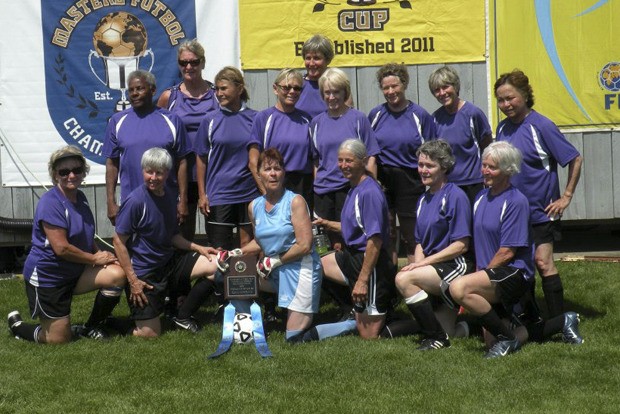
Fast forward to today, and Lasure still hasn’t slowed down. The 16-year Fall City resident, who holds a doctorate in genetics and runs an alpaca farm, is part of an over-65 women’s competitive soccer team. Lasure and the rest of the Baby Boomers won their championship this year, and Lasure continues to play the game, loving it even after 32 years on the pitch.
Beautiful game
Made up of women age 65 and older from the Seattle area, the Boomers won the first ever women’s Over 65 Division of the Masters Futbol Soccer Tournament in Bellingham last July. In the final game, the Baby Boomers beat a California team, Be Still Standing, by a score of 6 to 0.
The Boomers meet and play a few times a year; they’re all members of over-50 teams that have regular seasons. Lasure is part of the Fab 50, mostly Eastside residents.
She also plays in an over-55 club of sorts that numbers just enough players for two teams. Players draw cards from a deck, red or black, to determine which team they’re on.
The random draw can make for some surprises. Sometimes, there aren’t enough forwards, for example, to go around. The players have to improvise.
Lasure, who holds a doctorate in genetics, plays alongside grandmothers, homemakers, teachers, bankers and businesswomen.
She’s bonded to the sport because of its team dynamic. To her, soccer deserves its appellation of “The Beautiful Game.”
“There is something about it that’s difficult to describe,” she said. Part of it is the fact that game scores, at any age, are always so close. It’s rare at any level for a game to be a blowout. And there are few superstar egos in this team affair.
“You have to bring the ball down and share the ball,” Lasure said.
“To keep playing on a team, as you get older, you have to find ways to use people’s strengths,” Lasure said. “Young or old, you still have the distribution of skill levels and abilities—how far you can kick, how well you play defense, how competitive you are.”
Changing times
Lasure has had opportunities that her parents’ generation never had. And she faced obstacles that today’s girl soccer players probably can’t imagine.
“I grew up in Oklahoma, and there were no sports for women. None,” Lasure said. “I didn’t play any sports in high school.”
Her first sports experience came in college, on club basketball and softball teams.
Lasure started playing soccer at 33.
At the time, she worked for Miles Laboratories in Elkhart, Ind. There weren’t many sports available for women at the time, but some people in nearby South Bend, Ind., put together some women’s teams. Lasure joined them, and her lifetime love of soccer found its start.
“I’ve always been a person who exercises,” Lasure said.
She makes sure she gets plenty of aerobic exercise in the days before a game, and does strengthening exercises for her knees. She still walks and runs. One duty that keeps her in shape is the physical work of caring for 14 alpacas at Lasure’s farm, Big Rock Candy Mountain.
On the pitch
At games, Lasure laces on her cleats and shinguards, dons her purple jersey, and hits the field, sometimes for two full 45-minute halves. She plays soccer twice each week.
“If we’re lucky, we’ll have a sub,” she says. But a breather, thanks to a substitute player, isn’t always a given.
“People have busy lives,” Lasure explained.
There’s no coach, but organizing players may make strategy suggestions. Most teammates are deeply experienced. They know where they need to be.
The games are refereed by professionals, often younger men, who are sometimes taken aback by their charges.
“We have really young guys that get really giggly sometimes, because they’ve got all these gray-haired ladies making jokes,” Lasure said. The best refs, she said, get in and participate in the event of an injury.
“We’re very grateful to these young guys,” Lasure said. “We make sure we thank them.”
When an opponent isn’t too challenging, play slows down, to avoid a blowout. But when things get competitive, and they do, Lasure and her teammates really move.
“There’s always some young ones coming in, trying to take the ball away—there’s some young ones that get really mad because they can’t get around these old ladies.”
On the pitch, Lasure is a poacher as a forward. She has a good right foot, and snags rebounds or loose balls near the net. She contributed two goals in the championship finale with Be Still Standing this summer.
Despite their gray hairs, players’ tempers can get just as hot as younger players’.
“I’ve never seen a red card given, but I have personally been confronted with players that get so mad, the referee said, ‘You have to stop it,’” she said.
In today’s game, “You’re on forgiving surfaces,” Lasure added. Most of the regional playfields that the Boomers and Lasure’s over-50 team practice and play on are artificial turf. That’s a far cry from the hard, dusty real turf fields she started on here two decades ago.
“In the last 15 years, the fields around here have been improved. They’re all pretty magnificent,” Lasure said.
Asked whether she feels that what she does is inspiring, Lasure thinks for a moment. Other people could do what she does, she answers, if they wanted to.
“There are people on my team who keep playing because they like the game,” she said. “It’s a way of getting exercise (by) doing something, rather than going to the gym and riding a cycle.”
Soccer remains a highlight of her week, even after three-plus decades of play.
“It’s difficult to get completely focused and lost in something, so that everything else is suspended,” Lasure said. “But in a soccer game, that’s what happens.”