Growing the future, saving the soil; Author draws attention to Snoqualmie Valley farms’ mission for change
Published 5:41 pm Sunday, September 18, 2011
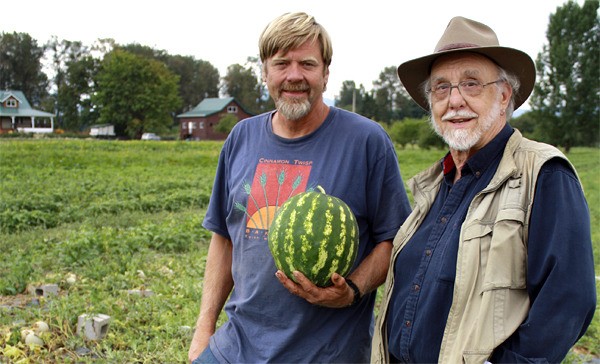
Yellow juice drips down Jerry Mader’s beard as he bites into a slice of Yellow Doll.
Next to him, orange utility knife in hand, Erick Haakenson cuts another piece from the watermelon, which moments before had been resting at the end of a vine in Haakenson’s field.
Spitting seeds, both men slurp the bounty of Carnation’s Jubilee Farm. Mader has spent many hours here, both as a customer of Haakenson, a Valley historian, and as a person who takes food very seriously.
“Eating is a political act,” Mader says. By going straight to the farm, “I’m making a statement about the relationship between me and other people.”
Jubilee Farm is one of nine Snoqualmie Valley farms documented in Mader’s new book, “Saving the Soil—The New American Farmer.” In it, he uses verbatim oral histories and photographs to show how local farmers are trying to change the world, through their farm practices and their efforts to reach consumers.
The new farmers
Mader, a recent arrival in Carnation, came to the subject of “Saving the soil” in a roundabout way. Moving with his wife from Seattle’s Fremont neighborhood, he began to notice longtime residents—Mader describes them as “real characters.” His book “Carnation Verbatim—A Snoqualmie Valley Memoir” told their stories and shared their faces; his photographs still hang in Pete’s Club Grill.
Passionate about food, Mader began exploring Valley farms—and more important, meeting the farmers. To him, it’s vital to know where his food comes from and who grows it.
Mader was struck by the similarities between the people who were producing the vegetables and meat he eats.
“Most of them, with few exceptions, have little or no farming background,” he said. “They’ve all come to this via books, or their own personal or philosophical quest to find a life they want to live.”
Most have advanced degrees, corporate backgrounds, suburban origins, “and have turned away… to enter the risky business of being a row cropper,” Mader said.
Researching his book, Mader spent a day in the life of the farmers, learning about ways they are eschewing old, big-business practices in favor or preserving the soil’s fertility for the long run.
A century or so ago, Mader says, nearly half the population of the United States was engaged in growing food.
“Less than one percent of the nation today are farmers,” he said. “Who is going to grow our food 20 years from now?”
If Mader’s work is any indication, probably people like Haakenson, who opened Jubilee Farm with his wife Wendy about 20 years ago. In Carnation, they explore the future of farming, eliminating foreign chemicals while espousing community-supported agriculture, or CSA, agreements, in which customers form partnerships with farmers in exchange for food. During Mader’s latest visit last week, young families wandered the rows, picked produce and gave scraps to a pair of well-fed pigs.
Better practices
Erick Haakenson pushes the straw aside and sticks his hand right into the manure. The warm pile, all 100 tons of it, came from pigs, but it will compost over the winter and become black gold to his vegetable fields next spring.
“It’s going to enrich the soil,” Haakenson said. “Instead of feeding the plants, we feed the soil, and trust that it will feed the plants.”
By the watermelons, Haakenson has tilled a fallow field. Some farms might keep all fields in production and supplement with petroleum-based fertilizers, but Haakenson enriches using time and cover crops like peas.
“This is the way people replenished the soil in the past,” Mader comments.
Mader’s research has found that globally, on average, an inch of the world’s three feet topsoil is eroded each year. It takes natural processes 100 years to create that inch. But farmers like Haakenson, with their aggressive composting, can do it in 10 years.
According to Mader, one acre of organic, chemical free farmland can produce ten tons of mixed vegetables, enough to feed 2500 people annually, at 80 pounds per person. He estimates that preserved farmland in King County could produce 22 million pounds of fresh wholesome food per year, enough for almost three times the combined population of the Snoqualmie Valley, some 300,000 people.
Besides soil conservation, farms promoted in Mader’s book also make efforts to preserve the watershed.
“A lot of them are salmon-safe farms,” he said. “They’re encouraging the extension service to come out. They’re helping them rebuild buffer zones along the river,” helping with flood control, “everything they can think of doing,” he said.
Mader said the time is coming when farming, globally, will change dramatically.
“Sooner or later, we are not going to be able to offer food that comes from thousands of miles away,” he said.
“We are going to look back on this as the age of squandering resources,” Haakenson added, “almost an attack on the earth.”
Get involved
This fall is a promising time for Mader’s cause. This Thursday, he holds a book signing at Carnation Tree Farm. This weekend is the King County and WSU Extension Office’s annual Farm Tour in the Snoqualmie Valley. And coming up soon, Sno-Valley Tilth holds its annual benefit dinner and auction at Haakenson’s farm.
“People are hungry for good food,” said Mader. “They don’t know how to get it.
He tells such consumers to “go find a farm.”
“The person who grows your food is like you,” Mader said. “He came to this from a middle class, suburban life. He said, ‘I want to grow food.’
“Meet the people. See what they do,” he adds. “Taste the food.”
King County farm tours
Families can experience local food and the farm economy first-hand during Fall Harvest Farm Tours Sept. 24, 25 and Oct. 1 in the Snoqualmie Valley.
Children’s activities, chef demonstrations, wine tastings, pumpkin patches, farm animals, weaving shows and history exhibits are on the tour.
Participating local farms include Oxbow Center and Organic Farm, Carnation Tree Farm, Jubilee Farm, Fall City Farms, Baxter Barn, Dog Mountain Farm and Alpacas at Legacy Ranch.
The tours are held by the Washington State University Extension Office with help from a number of partners.
A free downloadable guide is available online.
Book signing
Jerry Mader hosts a book signing party for “Saving the Soil,” 7 to 10 p.m. Thursday, Sept. 22, at Carnation Tree Farm, 31523 N.E. 40th St.
The event includes a virtual farm tour, author’s presentation and music by Big Dirt.
The book is available for $39.95 at www.toltriverpress.com or by calling Tolt River Press, 425-333-6989.
• You can also learn about Jubilee Farm’s organic practices at www.jubileefarm.org/