Local doctor gives the gift of sight
Published 2:46 pm Thursday, October 2, 2008
With 7,000 pairs of eye glasses stashed in their luggage, about a dozen doctors and staff members set off
to Mexico to give the gift of sight to people who might never have seen
a clear day in their lives.
The group was part of the Volunteer Optometric Services to
Humanity (VOSH) _ Northwest, a non-profit organization dedicated to
providing eye care to people around the world.
The latest VOSH-Northwest mission took the team to a
lower/middle class community in Puerto Vallarta where it worked with the
government to conduct eye exams and distribute glasses to the people.
The eight doctors and six staff members managed to visit with
2,100 patients during their five-day outreach, which kept them at the
community center for at least 12 hours each day.
“You’d like to see everyone but it doesn’t work out that way,” said
Dr. Bryan Karrick, of Snoqualmie Valley Eyecare. “People had
pre-appointments, but on the third and fourth day, many of them came back with
their entire family.”
It was the first time that Karrick and his wife Kimberley went on a
volunteer trip with VOSH-Northwest. Their interest in global
community service grew from Bryan’s involvement with the Snoqualmie Valley
Rotary Club, which is working with a hospital in Guatemala. One of
the wishes the hospital had was for an optometrist to serve some of the
patients there. But, Bryan realized that it would take a whole team of volunteers
to fulfill the need, so he began looking for an outlet to use his skills.
That’s when he found VOSH-Northwest, a 20-year-old
organization that has 100 members in Washington, Alaska, Idaho, Montana and
Oregon. The chapter is part of VOSH International, which was founded in 1972
by Dr. Franklin Harms of Kansas.
Since its inception, the Northwest group has traveled to
Columbia, Trinidad and Honduras, and plans to venture to Thailand next year, said
the group’s president Stuart Frank.
Frank has been on five missions and co-lead the latest Mexico trip.
He said that he became involved with VOSH because, like the Karricks,
he always had a passion for community service.
“This gives me a chance to provide something to people in need,”
he said. “And when I see a Guatemalan seamstress put on glasses and
thread a needle or a child who [can focus only on things three inches from his
face] who didn’t realize that there were leaves on trees, it’s heartwarming
to see that.”
Like many of the missions Frank has been on before, the Puerto
Vallarta trip was no different. There were hoards of people wanting to take
advantage of the free service and most of them have never been to an
eye doctor before.
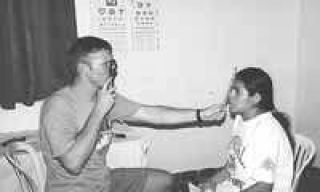
The volunteers worked in three areas: giving eye exams,
determining the person’s prescription and finding a suitable pair of glasses.
It was especially challenging for the people who had to match the
patients with the eyeglasses. Since the items were all donated there were
no custom made matches, everything was based on luck. The glasses needed
to not only match the person’s prescription, but they also needed to fit
their face.
“Contrary to what a lot of people might think, under correcting
doesn’t hurt anything,” Bryan said. “And
we’ll under correct them so we don’t cause injury.”
But once the person was fitted with the right pair, it made the long
hours and sweltering Mexican heat seem worth it for the volunteers.
“Most people were very thankful and gracious. They would stand
up and give you a kiss because they couldn’t read for years because of
their eyes,” Kimberley said. “But then
they would put the glasses in their bag and walk out.”
Bryan guesses that the people probably valued the glasses so
much that they didn’t want to put them on, for fear that they might break or
lose them. For many, this was their first pair of spectacles they have ever owned.
“Glasses are truly a luxury item,” he said, explaining that most of
the residents only make $3 to $5 a day in wages, with professionals topping
out at $10 a day. “Even psychologists can’t make enough money to get
eye care.”
During the exam, doctors found that many of the patients had
more serious eye problems including cataracts, glaucoma and diabetes _
conditions that they weren’t equipped to treat.
“I saw more cataracts in one day than I see in a year,” Bryan
commented.
However, money proved to be an obstacle for the people again,
and many of them conceded that they would lose their eyesight in the
next few years. The government is currently looking for a group of
doctors who would be willing to perform the nearly 600 cataract surgeries
needed in the community, but until then, the residents of Puerto Vallarta have
little hope in resolving the problem.
“Some of the little kids have horrible eye problems that weren’t
addressed, so the experience was depressing and rewarding,” Bryan said.
“Because it is good and bad, you have to look at the positive that
you’re helping people vision-wise be able to read,” Kimberley added. “You
hope that the surgeries happen, but to know you improved their quality of life
is rewarding.”
The mission’s success doesn’t only depend on trips abroad. All year
round the volunteers collect donated glasses from churches, service clubs,
optical companies and the Lions Club. To donate usable glasses to
VOSH-Northwest, drop them off at Snoqualmie Valley Eyecare, 408 Main Ave. S.
in North Bend.