City of Snoqualmie acquires tree farm
Published 3:30 pm Thursday, October 2, 2008
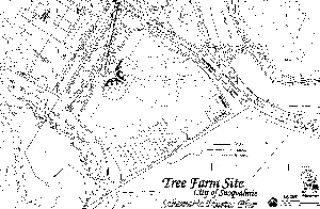
The Candy Cane Tree Farm on Park Street – long a source of
contention between its owners, Don and Lynn Douglass, and the
city of Snoqualmie – finally met its fate late last Wednesday
afternoon.
In a surprise development, the city and the Douglasses finally
reached an agreement on the sale of the property. The action
ended the threat of condemnation proceedings for the land and
apparently ended a longstanding controversy over the farm’s
future ownership and use.
In separate interviews, Don Douglass and City Administrator
Kim Wilde stated the Douglasses will receive $310,000 for their
property. They will also retain the right to harvest trees from
it for two more seasons.
“It hasn’t closed yet, but we do have a signed purchase
and sale agreement,” said Wilde last Thursday. “We’re
really excited. We think we’ve reached a fair agreement and
anticipate constructing a park in 2001.
“We anticipate building three baseball fields on the site
and a youth football field, which could also be used for younger
soccer players. It will be designed in a way that it could host
tournaments and raise revenues for the parks department.
“We think it’s really one of the few sites in the city
limits in which to build a recreation complex,” Wilde
continued. “It’s nice and level and has all the topographic
characteristics you’d want in a site.”
Don Douglass, who bought the 20-acre property in 1985 for
$110,000, was a little less sanguine when contacted Friday. He
stressed that he and his wife were happy with the prospect of
having a place for local youth, but still felt they hadn’t
received full value for their business site.
“One thing, first of all, we’re very happy the kids will
have a good park for productive pursuits,” he stated,
“rather than hanging around convenience store parking lots.
They need it.
“However, it sort of cut our business in two; suddenly we
have half a business. We told the city about that, and they gave
us two years’ cutting rights on it.”
The worth of the property was the primary sticking point
between the two parties and ultimately led to the threat of
condemnation by the city under eminent domain. Under that
practice cities are able to legally acquire land that property
owners are unwilling to sell through condemnation.
The Candy Cane Tree Farm was initially identified as a
potential park site in the city’s Open Spaces, Parks and
Recreation Comprehensive Plan. After initial negotiations, the
topic was pulled from the council’s May 10 meeting agenda and
condemnation procedures were initiated.
The Douglasses maintain they were never informed by city
officials that their land was under consideration for
condemnation.
The dispute then settled into a “battle of
appraisals,” with each side getting differing figures for
the value of the land. The property owners stated their property
was a developed business, and not “raw land,” and
therefore worth more than what the city was offering. City
Administrator Wilde and City Clerk Jodi Warren advised they had a
fair appraisal, but it was not a public document, and therefore
not subject to public release.
“We valued the business – as far as we’re concerned – at
about $515,000,” said Douglass. “The city had one that
valued it as raw land – and it wasn’t raw land, it was a business
– and they came up with about $244,000. We had one done that came
up with $370,000, and that was based on the fact it was a
business.”
“The city attorney ranted and raved, saying it was
unrealistic, `all we want to do is buy some raw land.’
Weyerhaeuser had their finger in it too, but I won’t go into
that.”
Reportedly, the Douglasses offered the land to Weyerhaeuser
for $675,000.
“We had three offers from private parties to buy that
farm,” Douglass continued, “but since the city had
threatened condemnation, we were unable to consider those offers.
They were all more than the city was willing to pay us.
“It would’ve gotten dragged into court, so we succeeded
in negotiating a price. We would have liked the $370,000, but
that’s not the way it went.”
For the city, nailing down the purchase of the property
finally settles the issue of the two parks required by the
Snoqualmie Ridge agreement. Wilde added the Ridge’s developers
will provide a large part of the funds for the new sports
complex, including some of the facilities they were required to
build.
“We felt this was an opportunity to get some of the
facilities that were to be built down here, in historic
Snoqualmie,” he said. “This is the culmination of
something we’ve worked on for a long time. For the first time,
we’ll have our own recreational facilities and fields.
“We need to give credit to the parks board,” Wilde
concluded. “They looked at several options, looked at
several ideas, and approved these plans. They deserve a lot of
credit, as does the city council.
“It’s really great we can do this in a way where we don’t
have to do a condemnation.”
As for the Douglasses, they will retain their other tree farm,
south of I-90 off exit 34, which Don Douglass referred to as
their “home farm.” Yet, he pointed out another
repercussion of the sale.
“We hire – in season – local young people from the high
school,” he commented. “We treat them real good, and we
don’t have to beg for their help. Since we treat them fair and
allow them to get good tips and a bonus each year, we have more
people wanting to work for us than we have a need for.
“For the most part, it’s their first real job,”
Douglass continued. “We take a real responsible position in
teaching them responsibility, in how to work and how to serve the
public.
“That opportunity will go away for Snoqualmie, but it
will continue to exist on our other property.”