What will $244 million buy? School bond proposes to update all schools in Snoqualmie Valley School District
Published 12:18 pm Thursday, January 8, 2015
It’s not a small bond, but Snoqualmie Valley School Board members say it is comprehensive. The $244.4 million issue that voters will settle in February would fund needed building repairs, solve crowding problems at the elementary and middle schools, and modernize and expand Mount Si High School, if passed.
The problem is, it’s expensive. Proposition 1 would cost tax-payers an additional $1.29 per $1,000 of 2015 assessed property value, starting with their 2016 tax bills. That’s $516 annually, or $43 per month, for a $400,000 property, in extra school taxes.
Opponents of the bond, speaking at school board meetings over the past year, worried about the expense. They said voters would reject a bond with such a high price tag, or that they couldn’t personally afford the tax increase. Bond supporters, also speaking to the board, agreed that it was expensive, but, considering inflation and current low construction bids, building will never be cheaper. Also, the school capacity needs are urgent
“There are some big, big problems that are staring us in the face,” said Snoqualmie Valley Schools Superintendent Joel Aune.
For instance, “we have about 30 percent of our elementary students in portables,” and a looming state requirement for districts to eliminate half-day Kindergarten in favor of all-day programs, estimated to start in 2017 here, would effectively reduce each school’s classroom count. “With our half-day program, we can educate 48 students in one classroom,” he said, half of them in the morning, the other half in the afternoon.
At each of the two middle schools, enrollment is above 700, near the building maximums even with the portable classrooms placed last year. And the high school, built piecemeal over the past 60 years, stands in a floodway and is showing its age. “We must address the high school,” Aune said. “It needs a significant refresh.”
Solutions to all of these problems are part of the bond. So, what are voters getting for their money? A new, 2,300-student Mount Si High School, the return of Snoqualmie Middle School, a sixth elementary school opening in the fall of 2016, and repairs to nearly every other district building.
High School
The plan: Specifics on the high school are not available yet; a high school visioning committee of teachers, students and parents and other school staff are expected to make their recommendations on the building later this month.
In general, however, the renovation would include flood-proofing some facilities, raising most of the high school buildings to above the floodway level, and more space overall. To accommodate up to 2,300 students, part of the construction will be three stories, on top of covered parking on the ground level; up to an acre of additional student parking will be needed, off site. The city of Snoqualmie has already adjusted its building regulations to permit a three-story building for the school.
A separate building, planned for the first phase of construction, would become the new freshman campus. Part of the main campus, the building would still allow freshmen to have their own space, which has so far yielded positive results in the Snoqualmie Valley.
Construction would be done in three phases, which may change as design and planning are done. Rough ideas proposed in initial conversations from about six months ago including the following phases:
Phase 1 construction includes a freshman building classrooms, and possibly new kitchens. Much of the construction would likely be on the existing school parking lot, with minimal demolition. Phase 1 is projected to be complete by the fall of 2019, opening with a student capacity of 2,100.
Phase 2 of construction would likely demolish much of the existing building on the west side of the campus, and rebuild space for the arts and theater, and the Career and Technical Education programs. Phase 2 could be complete in 2021.
Phase 3 construction could include administrative offices, an auxiliary gym and other components, complete by 2023.
No changes are planned for the sports fields or the existing gym, and the buildings overall are seismically sound, according to a 2012 seismic study of the school.
The finished school will have a capacity of 2,300 students when complete, making it one of the largest high schools in the state. The size concern is outweighed by the unique nature of the school, though.
“Part of what makes the district special is the single high school; a place where everyone — students and community alike — can come together,” said Aune.
“We call it the one crown jewel of the Valley,” added Kirk Harris, president of Snoqualmie Valley Citizens for Schools, which is campaigning in support of the bond.
The need: Parts of Mount Si High School are built in a floodway. The buildings need to be elevated and stabilized against earthquakes. The remodel will expand science labs and performing arts programs, replace roofing, and generally update the aging building.
In their work to develop the bond proposal, Aune said school board members were conscious of the district’s feelings about the high school, and the history of failed attempts to pass a bond in 2007 and 2008 to build a second traditional high school — the district’s alternative school, Two Rivers, serves both middle- and high-school students.
“In those elections, we learned that a number of people in our community feel that this is not a two-high-school district,” Aune said, adding that it’s “one of the most difficult transitions for a community to make.”
Aune also noted that high school project would include the restoration of the freshman campus building to operation as Snoqualmie Middle School. Construction of a third middle school is estimated at $60 million, which is, in a sense, money saved.
Public tours of Mount Si High School are planned for 7 p.m., Thursday, Jan. 15 and Wednesday, Jan. 21.
Elementary school
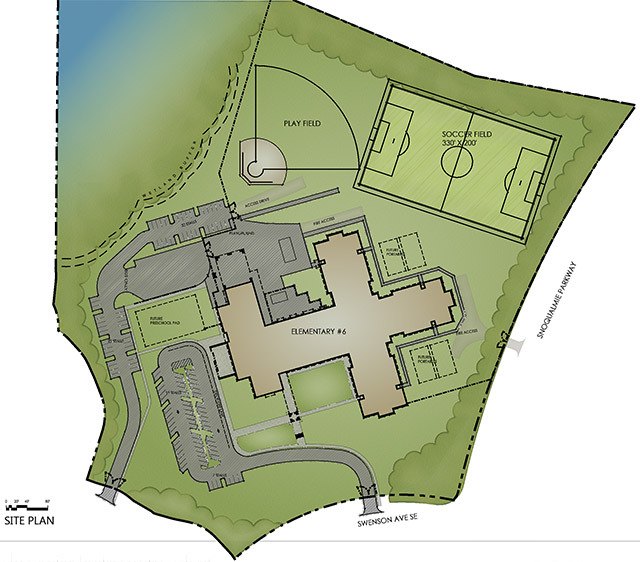
The plan: The sixth elementary school will be built on a property along Snoqualmie Parkway, with driveways onto Swenson Avenue Southeast. The 71,000 square-foot building will have 31 classrooms, plus a separate building for the state-required preschool program. Capacity of the building is projected to be 650.
Using existing designs from the 2005 Cascade View Elementary School project, with staff recommended changes, the district has already completed much of the preliminary work on the school, and construction could start this summer, if the bond is successful. Initial plan review and permitting costs, estimated at $2 million to date, were initially funded with already-received school impact fees.
The need: Elementary enrollment continues to grow, and the district’s brick-and-mortar buildings aren’t big enough for all the students
Class size recommendations from the state legislature, unfunded in the past and so not implemented within the district, would require significantly more classrooms, at the current enrollment levels. Assistant co-superintendent Ryan Stokes, who reported these numbers to the school board last summer and last month added that this projection did not include the full-day Kindergarten requirement.
For now, there are barely enough classrooms for elementary age students, but they aren’t all where they are needed.
Harris said he’s been hearing from parents who are concerned about the number — about 250 — of Snoqualmie children who ride the bus every day to Fall City Elementary School.
“I think that’s where people understand the need best,” said Harris.
Everything else
The plan: Over the two years of discussing the bond, the Snoqualmie Valley School Board has identified a prioritized list of repairs and upgrades to be made at nearly all school buildings.
The need: These include roof replacements at North Bend, Snoqualmie and Fall City Elementaries and the freshman campus building, new boilers at SES and the freshman campus, a new septic system at FCE, a new gym at SES, safety improvements at all schools and new fire alarm systems at NBE and FCE, new flooring at Opstad and Two Rivers, and resurfacing sports fields at Mount Si and Chief Kanim Middle School.
For a full list of projects, visit http://www.svsd410.org/Page/4828.
Next week, the Record will examine enrollment trends that have affected growth in the district.
Aune and Harris will share information about the bond proposal Friday, Jan. 16, at the Snoqualmie Valley Chamber of Commerce monthly luncheon.
 Entrance design for the new proposed elementary school.

A rough drawing of the new Mount Si High School shows the possible structure and phasing of construction. Phase 1, in orange would include a stand-alone freshman building, among other possibilities. Phase 2 is in blue, and Phase 3 in pink.