
SEATTLE _ A decision was supposed to have been made last
Monday in yet another urban sprawl vs. developer’s rights struggle.
The Metropolitan King County Council was scheduled to approve
or deny the application for the proposed Treemont housing development
on April 24.
Instead, the council postponed their decision until June 5.
The Treemont property is a 239-acre site owned by Port Blakely
Communities, a local development company that plans to build a
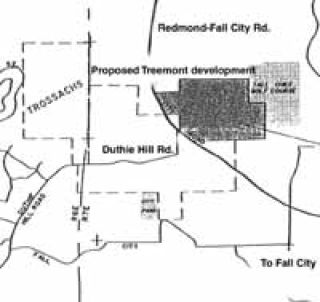
194-home subdivision on the land. The plat sits above State Route 202 near the
Tall Chief Golf Course in Fall City.
Hearings for the project were held late last year, which gave
Hearing Examiner Stafford Smith a few months to make a final
recommendation to the council. He recommended approval in February.
But the county council’s decision on the project has been delayed at
least twice.
The first delay was caused by an appeal filed by Robert Seana, a
farmer who owns land near the Port Blakely property, in response to the
examiner’s recommendation. Seana and several of his neighbors opposed the
development because they were concerned about the subdivision’s impact on
their community.
“It is wrong to put a suburban development in this rural area,”
Seana told the council. “My neighbors and I have organized two community
associations to fight this development, and we will not give up until the
public interest prevails. We have no choice but to fight.”
Seana stated that he believes Treemont will cause flooding and
traffic congestion in the area as well as pose a threat to Patterson Creek,
which is a known salmon habitat.
Seana represented more than 20 of his neighbors who attended
Monday’s meeting when he spoke before the council.
“Our rural way of life is at risk,” he said.
County council members decided to postpone their vote until June
because they wanted to have more time to review the project’s details.
Both Seana and Port Blakely attorney Robert Johns were allowed
an extra 15 minutes in the recent meeting to make their statements.
Johns told the council that Seana had fed them misinformation
concerning Treemont’s potential impact on the environment and the area’s “rural
character.”
Johns explained that Port Blakely has spent more than 11 years
doing the required research involving impacts on neighboring property,
roads and streams and has complied with all government standards.
In 1988, Port Blakely applied for county approval to build their
project. According to a document from King County’s Office of the Hearing
Examiner, the land was vested the same year, making it subject to the general
zoning laws current at that time.
Since then, the area has been re-zoned to a rural classification,
allowing one home per five acres of land, instead of the one house per one
acre allowance under the general zoning requirements that Port Blakely is
operating under.
Originally, the subdivision was slated to have 236 homes, but after
a few years of study, the developers decided to pare down to 194 homes
to allow for a larger buffer area between Treemont and neighboring land,
said Port Blakely Vice President John Adams.
In addition to the buffer, the project has evolved to include a new road
to the property that will provide direct access from the subdivision to
the Redmond-Fall City Road. Also, a traffic signal will be installed at S.R.
202 and Duthie Hill Road. These measures were designed to reduce traffic
problems.
The county will also require the developers to install a
quarter-mile- long drainage pipe, which would divert runoff water into the
Snoqualmie River instead of letting it flow into Patterson Creek, which floods
seasonally.
The water diversion pipe is designed to prevent the flooding
of neighboring land while protecting the creek. Under the plan, Patterson
Creek will continue to receive its usual amount of runoff, while
the Snoqualmie River would only rise 4/1000th of one foot from the
added water, Johns said.
The road and pipe are the main points of controversy for
neighbors, but Johns insists the county requested those changes and the developer
was just doing their job by complying.
“Port Blakely has a reputation for building and maintaining
environmentally sound projects,” he said. “If
we were creating the impacts that are suggested, then we would change
the project to avoid those. And in fact we did make a lot of changes.”
However, Seana still believes that despite any mitigation
efforts, Treemont will flood the land and spoil Patterson Creek and its salmon.
Seana, who heads the group called Neighbors Against Flooding,
questions the variances that the council has allowed on the project.
“Wherever Treemont does not meet exceptions, King County
gives them variances so they can do just about anything they want,” he said.
Johns said that the opposite is true, that the variances were granted in
order to mitigate any negative impacts.
“You’ve been given the impression by Mr. Seana that variances are
bad,” Johns said to the council, explaining how they are geared to protect the
land and water.
Adams said that the examiner’s recommendation to approve
the project was based on years of study and Port Blakely is willing to
comply with any county-imposed regulations.
“I think there’s an assertion that we are not studying this enough or
doing enough studies,” he said during an interview last week. “But a
tremendous amount of time and work has gone into these reports. We think we are
doing an environmentally sound project that will not have any impact on
salmon, flooding or other issues brought up by neighbors.”
Treemont neighbor Cindy Parks has formed a coalition called
Friends Against Excessive Development and said that she wants the council to
listen to residents.
“Here we are, just a bunch of individuals having to battle against
the developers, their lawyers and consultants, and surprisingly, King
County. You would think that the county would be on our side, trying to enforce
the rules,” she said.
The King County Council is scheduled to vote on the
subdivision on June 5. If Treemont is approved, Port Blakely plans to begin the
project by the end of this year.

