
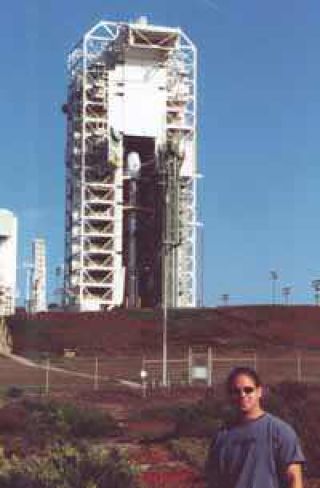
When you watch satellite images on the Weather Channel or local newscasts, you are witnessing the work
of a Mount Si High School graduate.
Rob Osborne, who graduated in 1992, is a spacecraft test director
for Lockheed Martin Space Systems Company in Sunnyvale, Calif.
His job entails putting together and testing satellites that monitor
global weather patterns and pick up emergency distress signals from ships
and aircraft.
The satellites are used for short- and long-term weather forecasting,
to monitor severe storms, for measuring temperature and humidity and for
providing data on soil moisture, polar ice coverage, ocean currents and
the ozone layer. The system works with two satellites that orbit the Earth
and provides us with data not less than six hours old.
The satellite program was started in 1978 by the National Oceanic
and Atmospheric Administration (NOAA) and the National Aeronautics
and Space Administration (NASA). It has produced 14 satellites, including
the most recent, the NOAA-L.
Osborne, 26, is currently working on the NOAA-N model, and
recently completed the NOAA-M, which will be launched next June. He also
worked on the NOAA-L and watched it take off on a Titan II rocket Sept. 21.
“It was like a dream come true, after all the years of encouraging
and supporting, it kind of culminated at that explosive moment,”
said Osborne’s mother, Elena Montgomery, who witnessed the launch.
Montgomery is the treasurer for the city of North Bend.
Osborne said his job is important because the satellites cost about
$150 million, and they must be launched without a mistake. He added that
taxpayers’ money would also be wasted if the satellite fails.
The best parts of his job, Osborne explained, is the level of
responsibility he is entrusted with, and launch days.
“You spend two, three years putting these things together, and
it’s amazing to see it work,” he said.
“My fingerprints are all over space right now — there’s not a part of that
satellite that I didn’t touch.”
But this job is just one step toward Osborne’s goal of becoming an
astronaut.
Next year, Osborne will apply for the astronaut program. If he isn’t
accepted, he will go back to college for his doctorate.
“They get thousands of applicants, and they only take about 20,” he
said, explaining that applicants are screened on physical qualifications,
education, experience, even hobbies. “It’s
very difficult to get into, but so far, I can’t see anything that will keep me back.”
Montgomery noted that her son had always been inclined to break
free of Earth’s gravity.
“He says he knew when he was 9- years-old that he wanted to be an
astronaut,” she said, explaining that she could tell how talented he was by
the way he constructed things out of Legos and Erector sets. “He liked
to put anything together that he could get his hands on.”
After graduating from Mount Si, Osborne moved on to college. He
received his bachelor’s degree in aeronautical and astronautical
engineering in 1997 from the University of Washington, and his master’s degree
in aeronautics and astronautics from Stanford. Lockheed Martin paid
for his master’s degree.
He said the most difficult time of his life was when he was
attending Stanford and working full time at Lockheed Martin, sometimes
working graveyard shifts of 12 hours, then studying for midterms.
Osborne still sometimes works 14- to 16-hour days for two weeks in a
row while testing the satellites.
“He’s just got a tremendous amount of drive,
I can’t even keep up with him.”
Elena Montgomery
mother of Rob Osborne
However, Osborne wasn’t always this motivated. He described
himself as bored in elementary school because he was always quick to finish his
math problems and assignments, which left him less than challenged.
Both Osborne and his mother credit two Snoqualmie
Elementary schoolteachers with his turnaround.
“One of the things that I’m thankful for is that a couple of teachers
in the valley, Mr. Lee and Mrs. Dorland, nurtured his talent,” Montgomery
said. She explained that they motivated him, understood his learning style and
his aptitude for science and math.
The teachers have since retired, but will never retire from
Osborne’s memory.
And neither will Gene Clegg, physics and chemistry teacher
at Mount Si.
“He’s a very upbeat inspirational type of guy,” Osborne said. “One
of his favorite expressions was, `You guys are smarter than me, but I’ve
just been around longer.'”
Clegg, who has taught 33 years, remembers Osborne.
“He was a very bright student,” Clegg said. “He was one of the
students who was willing to get his feet wet and challenge answers. I knew
he was going to be a leader.”
Osborne’s advice for students is to select a career path in life and go
to college.
“Choose something that you want to do. Choose anything, even
now. Choose and figure out what steps you need to take to do it,” he said.
“You’re going to have to do something every day, so you might as well like it.
It doesn’t have to be a lifetime decision. Whatever sounds best to you — do
it. You can always change your mind later.”
“Oh, and have fun, too. That’s very important,” he added. “The key is
to be happy and have fun.”
Hang-gliding, hunting, fishing, camping and scuba diving are the
activities Osborne prefers to balance his life.
“You can’t get too locked into one thing or you get bored,” he said.
Another way Osborne balances his life is to spend time with his
dog, Lakota, which is part German Shepherd, wolf and husky. He also stays
in touch with his UW buddies and with his sister, Sara, who is a fellow
Mount Si and UW graduate and is studying law in Washington, DC.
Although he has inspirational phrases posted around his
office, Osborne offered his own words to Valley students on how to be
successful.
“Believe that you can do what you want to do,” he said. “It doesn’t
matter where you’re from or what you’ve done in the past, you can figure
out how to do it. Don’t listen to what they say if they say you can’t do it.”

