

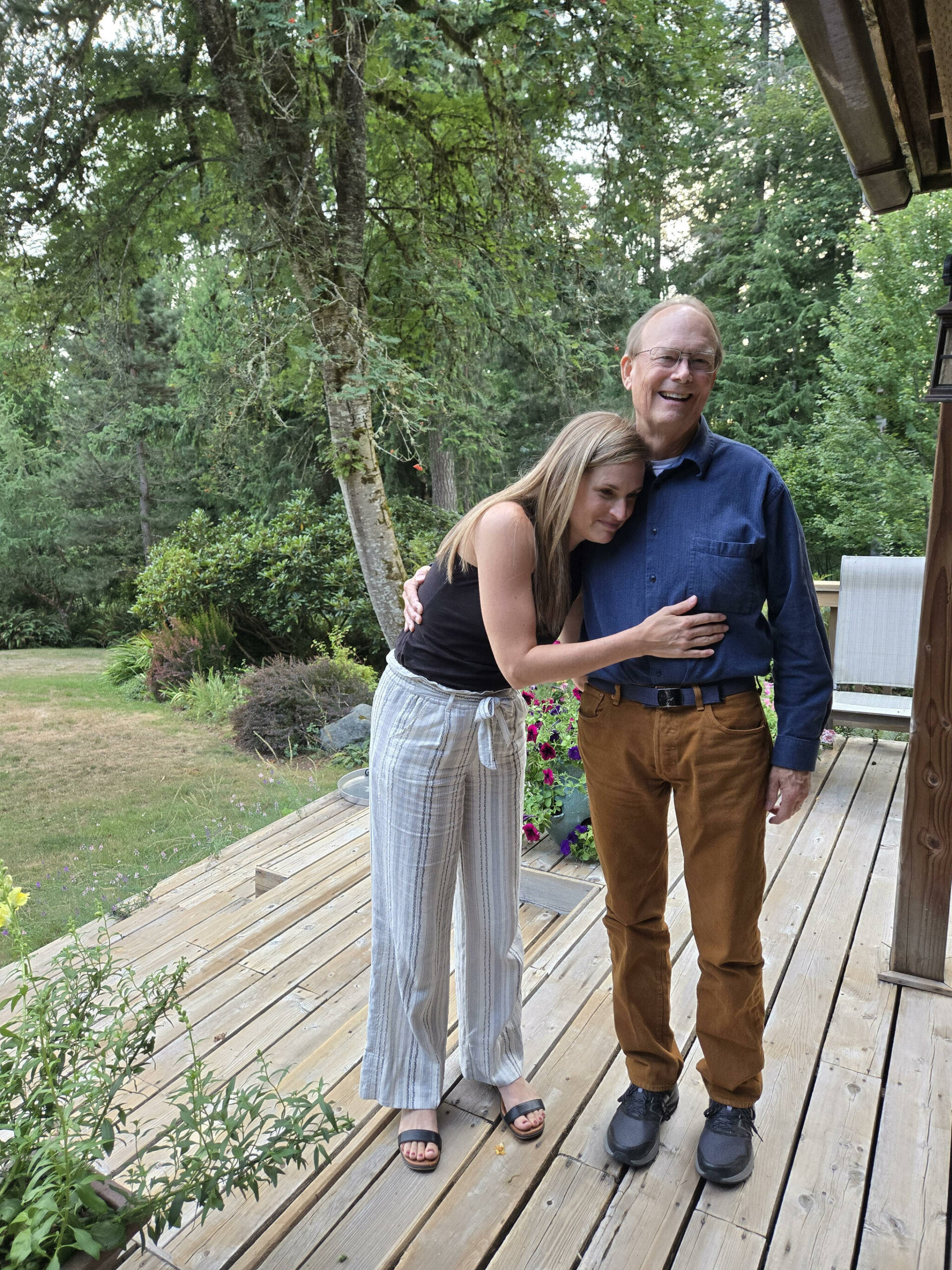
Dave Eiffert, a longtime Snoqualmie resident and career social worker, has always been a helping hand to the community.
Now, he’s reluctantly asking for help of his own.
Eiffert is in need of a kidney transplant and has taken it upon himself to look for a donor. He is currently one of 500 people on the University of Washington Medicine’s kidney transplant list, where the estimated wait time is three to five years.
Eiffert’s kidney failure is a result of medications he took after he had a double lung transplant. The transplant went well, he said, and his body accepted the new organs without issue.
But around 15% of individuals who get lung transplants experience kidney failure, due to the immunosuppressant drugs they have to take, and Eiffert ended up in that boat.
Knowing firsthand how difficult waiting for a transplant can be — and knowing secondhand how tiresome dialysis is — Eiffert decided he might as well try to help others move off the transplant list, too.
“I thought, well, if I’m trying to scare up a kidney for myself, is there some way that I can parlay that into finding kidneys for nine other people?” he said. “Just make it a nice even 10.”
So, Eiffert is turning to his community, though he is known by his friends and neighbors as someone who does not ask for help.
“I got over that because I’m up against the wall,” he said. “I’ve got to just grin and bear it because three to five years is too long.”
The widow of Dave Eiffert’s lung donor listens to his new lungs. Photo courtesy of Dave Eiffert
Eiffert’s journey
A little more than four years ago, Eiffert developed a persistent cough, followed by shortness of breath. He was diagnosed with idiopathic pulmonary fibrosis, a chronic lung disease where irreversible scarring of the lung tissue hinders oxygen.
Eiffert found out he was sick in the fall of 2021, was put on the transplant list in March 2022, and got his transplant “astonishingly fast,” just eight days later.
“I was really the poster child for recovery,” he said. “I didn’t have any side effects.”
But then, flu-like symptoms sent Eiffert to his pulmonologist, where he learned his lung donor had cytomegalovirus, a variation of herpes.
“In general, they start treating it when your viral load is at 200. I was at 2 million,” he said. “My pulmonologist said, ‘You’re not the sickest guy I’ve ever seen, but you’re right there.’”
Eiffert was put on foscarnet, a drug used to treat cytomegalovirus in immunocompromised individuals. The medication is “really hard on your kidneys,” he said, though he noted that no immunosuppressants are good for the kidneys.
Eiffert is now waiting for a transplant. He is not yet at the point of needing dialysis — a treatment that filters a person’s blood when their kidneys no longer can — but his kidney function continues to decline.
“I just drew a short straw,” he said.
Finding a match
The system to determine whether a donor is compatible with a recipient — and how strong the match is — is a complex system. It involves blood type, tissue type and crossmatching, a test that shows if the recipient’s immune system is likely to attack the donated kidney, according to the National Kidney Registry.
The better the match, the more likely it is that there will be a successful transplant.
So far, Eiffert’s wife, son and a close friend have begun testing. The process is quite involved, Eiffert said, including questionnaires and a couple of interviews, including a psychiatric interview.
Eiffert said interviewers take into consideration a potential donor’s lifestyle, age and own medical conditions.
“If you’re old or in middle age, you can’t be on more than one blood pressure medication. If you’re young, you can’t be on any. They’re hard on kidneys, too,” he said. “You can’t be a smoker of any type. You can’t be much of a drinker.”
If Eiffert finds a donor, he will cover the expenses, including all lost wages for time off work. He also said transplant donations are eligible for paid family and medical leave.
The medical procedure itself is straightforward, and there are no long-term effects to donating a kidney, Eiffert said.
“In fact, people who donate kidneys tend to live a little bit longer, and I think that’s because they probably take care of themselves better anyway to begin with,” he said.
A living-donor organ donation is most commonly done when a person names a specific transplant recipient. In this case, Eiffert is looking for altruistic donors — those who just simply donate a kidney, without specifying who for.
Eiffert also noted the potential for what’s known as a daisy chain transplant, formally called a never-ending altruistic donor chain.
The chain “begins when one altruistic donor (a donor without a designated recipient) donates a kidney to a person waiting for a transplant. That recipient’s willing — but incompatible — donor gives to another person waiting, and so on. Each living donor in this system gives to a stranger, and the chain of donors is kept going as long as possible,” according to the U.S. National Science Foundation.
The more Eiffert is able to spread the word about his mission, the more good he can do for himself and others on the list.
This is a big undertaking for someone in Eiffert’s condition, which leaves him with less energy than he’d like, he said. But he is determined to continue fighting and make each day count.
“I firmly believe that you can have a good attitude on purpose,” he said. “I will not waste my days. … Every day is a gift now because I would have been dead years ago. Some of them are a turd in a box, but they’re still a gift.”
To contact Eiffert, email daveeiffert@gmail.com or call 425-894-7970.

