Fishy business: Tropical aquarium finds a home at North Bend Elementary
Published 9:11 am Monday, July 8, 2013
When adults were around, the three Kindergarten boys staring at the large aquarium outside the North Bend Elementary School office kept a respectful distance. They had permission to come look at the tank, they announced.
When they thought no one was watching, their little face were inches from the glass, their eyes wide.
“Where’s the snake one?” the smallest asked.
“I know what that one is!” the blonde said.
He might have had a chance to name the fish he was pointing at, but just then a parent volunteer rounded the corner to bring him back to class. Only one of them, it turned out, got the teacher’s permission to visit the tank; the other two just tagged along.
Among the older students, the draw of the aquarium is just as strong. When Phil Lacefield Jr. asked for some fifth graders to help him change the water in the tank, five of them lined up.
“It’s cool!” the Green Team helpers, William Spellman, Sianna Crosser, Sedona Turner, Maddie Nowicki and Tristan Smothers agreed.
None of them had much experience with aquariums, so Lacefield, a member of the Greater Seattle Aquarium Society (www.gsas.org) which donated the tank to the school, used the project to teach them a few things about “the exciting life of a fish tank owner.”
First things first: That dark layer that’s forming in the gravel, that’s fish poo, Lacefield said. If too much of it builds up in the tank, the fish can get sick and die, which is why he changes the water every month or so. It’s also good fertilizer, so some of the water that comes out of the tank is saved for teachers to use to water their plants.
It got better, though. As students were busy filling buckets with the siphoned water, Lacefield talked about how the tank will change over time, and how, in a few months, another step could be added to the water-changing process.
“Then you get to pick out the baby fish,” Lacefield said.
Well, that job will probably fall to him more often, since Lacefield has volunteered as caretaker of the tank. It was part of the requirement to get the aquarium into the school, he explained.
“They’ve always had a philanthropy program to put tanks in classrooms,” Lacefield said of the aquarium society. “We have slowly but surely been putting tanks into schools.”
‘Let’s see what they do’
The program got a big boost two years ago, when a family pet exposition event donated all of its barely used aquarium and equipment to the society.
Any member can suggest a school to get a tank, as long as they can also suggest someone to maintain the tank for the school, Lacefield said, and since he lives so close to North Bend Elementary, he nominated the school and stepped up as caretaker. He installed the 75-gallon freshwater tank about six weeks before school let out, and planted it entirely with plants contributed from his family’s many fish tanks.
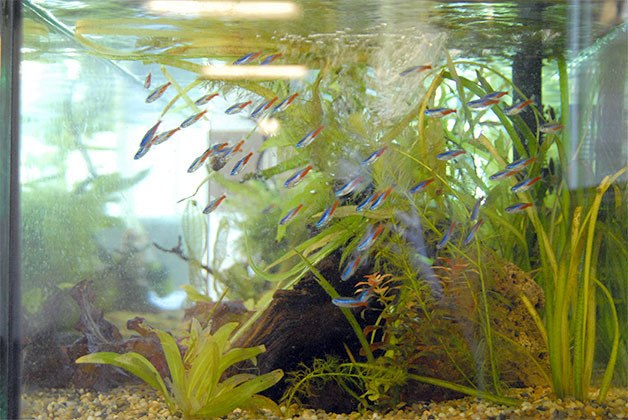
“All the critters in here are donated… from (society) members’ tanks,” he said, with one big exception, the shoal of blue-and-red Neon Tetras that claimed one corner of the tank as the water level dropped. Those were donated from a pet store, he said, delighted. “One thing I’ve always wanted to do was get 50 of them and put them in a tank, see what they do,” he grinned.
The total value of the society’s donation is estimated at $850.
Besides the stunning tetras, the tank includes freshwater fish from all over the world, and Lacefield has made identification cards, hung around the aquarium, with the images and scientific names of each fish, plus information on where they’re found.
North Bend Principal Jim Frazier is equally delighted with the tank, which he says is serving a dual purpose. “We’re using it for not only education, but having kids help maintain it,” he said.
Over the summer, Lacefield will take care of the tank at the same times that teachers come into the building to take care of their own tanks. The Green Team is also planning summer projects, but by fall, students will return to the tank, both as caretakers and fascinated onlookers.
“When we first set it up, groups would walk through the building and go ‘what the heck is that?!’” Lacefield said. “It was pretty cool.”

Green Team students Maddie Nowicki, Tristan Smothers, and William Spellman, front, and Sedona Turner and Sianna Crosser, back, learn about the tank;


Volunteer Phil Lacefield explains why and how to change the water.

A Corydoras swims in freshwater plants;