Meeting Monday discusses formation of new irrigation district in Valley
Published 1:04 pm Monday, November 2, 2015
An event that Washington state hasn’t seen in decades is taking shape this month, and it will be a very unusual shape, if affected voters approve it.
The Snoqualmie Valley Watershed Improvement District (referred to as an irrigation district in the state code that allows their formation, RCW 87.03) will have boundaries like a patchwork quilt, according to the King County ordinance to establish the district. The general boundaries will be the Snoqualmie Valley, from below Snoqualmie Falls to the Snohomish County border, but will include only specific sections and quarters, by township, and will exclude all cities in the Valley as well as parcels smaller than two acres, government property and rights-of-way for public, road, railroad and utility properties.
Most Valley residents won’t be represented in the district, being voted on as of Monday evening, Nov. 2, and won’t be subject to any taxes it levies, but could end up benefitting from its work, anyway. If 60 percent or more of the roughly 500 property owners in the proposed district approve it, the district can start work on plans to improve farming conditions and potentially reduce flooding risks for the entire Valley.
“One of these districts hadn’t been formed in this state for 73 years… I’m very excited about it,” said King County Councilwoman Kathy Lambert, adding that farmers face particular challenges with water in the Valley. Floods contribute a lot to the soil quality in the Valley, but “after the floods, we don’t have any water,” Lambert said. Dry summers mean most crops will need irrigation, but about 70 percent of the farmland in the Valley’s Agricultural Production District has no access to water rights.
Another problem for farmers is drainage, Lambert pointed out. After a flood, the silt-filled ditches drain very slowly, keeping farmers out of their fields until well into the spring.
“It’s very difficult to get permits to clean your ditches,” she said, because permits must be issued by the Army Corps of Engineers. This summer, King County cleared 12,000 lineal feet of its own ditches, compared to 5,000 feet in 2014, and none in 2013.
She hopes to simplify that process for all farmers, and envisioned a joint contract, with all Valley farmers, for cleaning out ditches in the future, as a benefit of the Snoqualmie Valley district, “… so people can clean ditches whenever silt reaches a certain level. Hopefully we can do it so the entire Valley can hire someone and have them do it all the way through, so that we can all benefit. The farmers know when the silt is there.”
A watershed improvement district would enable land owners to contract for services and utilities, but it also benefits the water rights holders, those farmers who are allowed to draw water from the Snoqualmie River to irrigate their crops.
“We wanted to be able to let farmers who have water rights sell their water to other people who need it,” Lambert explained.
But water rights are complex. “There are no new water rights,” said Cynthia Krass, executive director of the Snoqualmie Valley Preservation Alliance, which proposed the district. “If you got there first, you can get all your water, before the person behind you can get any of his water.”
And existing water rights can be lost — reverting back to the river itself — if they aren’t used.
Krass explained that water-rights-holders who do not draw the maximum amount of water allowed under their rights for five consecutive years, they lose the right to the amount they didn’t take. In a rainy year, farmers still have to draw water, or risk losing their future rights to it.
“There is no incentive to conserve. In fact, there’s a penalty to do it,” Krass said.
Temporary transfers of water rights are possible, but also very complex, requiring a thorough understanding of water rights law, Krass said. A watershed improvement district, however, can contract for the legal work needed for these transactions.
It also can levy a tax, a fee per acre, said Krass, but only on land within the district. “By law, it must be land that can be irrigated,” Krass said.
Ballots have been mailed for the formation of the watershed improvement district. All ballots must be returned by Nov. 24. The King County Clerk will determine the results and submit them to the Metropolitan King County Council for approval. If 60 percent of voters approve the district the council will formalize the law establishing the district. “Then they get to start operating, which is great, because they need to do a lot of work before the next growing season,” Lambert said.
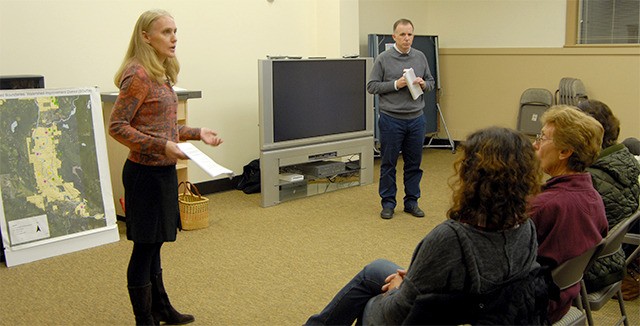
The Snoqualmie Valley Preservation Alliance hosted a public meeting on Monday, Nov. 2, to educate property owners on the district and introduce voters to the candidates running for a spot on the district’s board of directors.
For more information, visit www.svpa.us.

Property owner David Andrews introduced himself and his goals to a group of about 40 audience members Monday, at a public meeting on the proposed irrigation district.

David Casey, aspiring candidate to the irrigation district board, speaks in front of maps outlining the proposed district boundaries.

Irrigation district board candidate Matthew Benson speaks to a group of voters Monday.