Setting a river free
Published 2:57 pm Tuesday, May 26, 2015
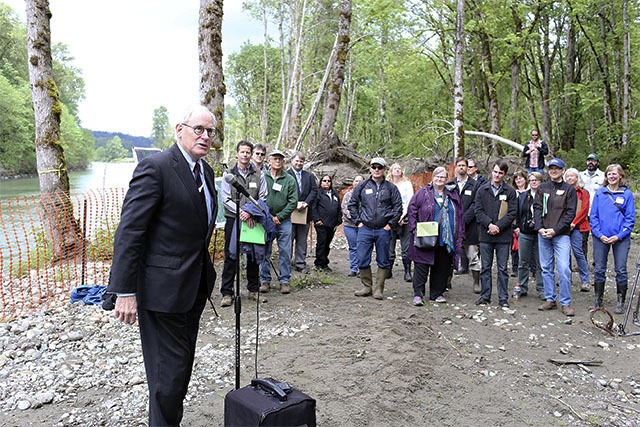
Representatives from organizations like the Washington State Recreation and Conservation Office, Kaleen Cottingham, and King County Deputy County Executive, Fred Jarrett, were few of the many who trudged through the muddy woods in Fall City to celebrate the completion of the Upper Carlson Floodplain Restoration project Thursday, May 14.
The Snoqualmie River habitat restoration project began with a feasibility study in 2010, as an effort to restore the Chinook salmon’s natural habitat and was completed on Oct. 10, though extending planting lasted longer.
The river reach below the Fall City bridge was closed from June 2 to Aug. 8 as the Department of Natural Resources (DNR) removed a 1,600-foot linear levee along the river bank and let nature takes its course.
“This was not an easy project to do, but I would point out to everyone that we did it,” said John Taylor, assistant division director of DNR’s water and land resources division. “It’s done. And we’re going to do more of these.”

John Taylor, assistant division director of DNR’s water and land resources division, speaks at the event. – Staff Photo
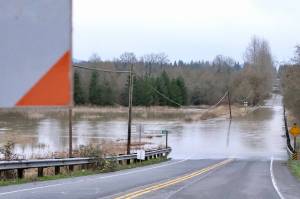
With the old levee gone, wintertime flooding brought fresh flows across much of the newly reconnected floodplain. After two major floods, the river has stretched its span by more than 50 feet and a gravel bar is already developing on the opposite bank.
As these natural processes are restored, gravel bars and log jams will provide additional salmon habitat.
Dan Eastman, project manager/senior ecologist, said the river’s projected to move 600 to 700 feet inland within 50 years and built wooden channel mitigations near the road to keep property safe.
“It’s expected (the river is) going to migrate a lot further than it has now,” he explained. “It’s going to respond rapidly until it gets to these trees, then it’s going to start to slow down. By year 10, the top of the bank will probably be in the river.”
To maintain protection for nearby homes, roads and fertile farmland, project managers designed and installed log structures and a new 850-foot-long rock structure at the lower end of the site to provide additional protection where the river is most likely to migrate.
Regarding the possibility of fire risk, Eastman said the extending river shouldn’t directly cause any harm.
“I don’t believe the river level has any direct effect on fire risk; it is merely an indication of unusually low snow pack and rainfall this year,” he stated. “The USGS Carnation flow gauge is currently at an all time low for this time of year. The project will have no effect on fire risk.”
The work was done on King County’s Fall City Natural Area, a 50-acre forested floodplain that historically contained the Snoqualmie River’s main stem.
King County acquired the Fall City Natural Area with funding from the Conservation Futures Levy and Salmon Recovery Funding Board, for preserving and restoring critical salmon habitat.
Site restoration work included invasive vegetation removal, and planting acres of native trees, to improve habitat for the birds, mammals, reptiles and other wildlife.
The $3.5 million project was funded by grants from:
• Washington State Salmon Recovery Funding Board and Puget Sound Acquisition and Restoration via Washington Recreation and Conservation Office and Puget Sound Partnership;
• National Oceanic and Atmospheric Administration via The Nature Conservancy;
• Coordinated Investment for Puget Sound Floodplains Initiative sponsored by The Nature Conservancy and administered by the Washington Department of Ecology;
• U.S. Environmental Protection Agency via the Snoqualmie Tribe;
• King County Flood Control District via Cooperative Watershed Management Grant; and
• King County Department of Natural Resources and Parks.