Fire season; Statewide drought emergency declared; Locals get prepared
Published 4:08 pm Tuesday, May 19, 2015
The one summer event no one wants to welcome early is upon us: Wildfire season. Starting on April 15, the season sprawls until October 15, affecting private and public lands, including 13 million acres of private and state forestland under the Department of Natural Resources (DNR).
With snowpacks only reaching 16 percent of its normal consistency, Washington State is experiencing the worst state-wide drought since 2005, according to the Department of Ecology. On Friday, May 15, Gov. Jay Inslee declared a state-spanning drought emergency, after his Emergency Water Executive Committee found 48 of 62 Washington watersheds reported water supplies at 75 percent of normal or below.
Fire season typically begins in early July and tapers off in late September, but the season shifted after the DNR recorded roughly 900 wildfires on more than 315,000 acres of its protected lands last year, adding up to the state’s worst fire season.
“They’ve certainly gotten bigger and more intense,” DNR assistant region manager for the South Puget Sound region, Doug McClelland, stated about the flourishing fires. McClelland, who spoke to the Record by phone, has worked in King County for more than 30 years and added that as more people move to the woods, they add heartier complications to the growing urban-fire interface problems.
To prepare for the dry season, DNR is bringing on fire crews early this year for training to protect their 12 million-acre span, but he said that during fire season, whether an employee’s job is trail maintenance or planting trees, it’s an “all-hands-on-deck” mentality.
Even though fires have changed, McClelland said what’s needed to suppress them hasn’t.
“What it takes to put out a fire has remained about the same,” he continued. “In reality, it takes hard-working people on the ground (to stop a fire). That hasn’t changed at all.”
Crew work can involve anything from building trails around a fire and implementing hefty or tedious tools like bulldozers or axes and shovels, split between a 10-to-20 person crew.

The Forest Service’s Type 3 engines are housed in a garage behind the office.
Safety begins with awareness.
“If we’re all safe in the woods, we’ll be just fine,” McClelland urged before signing off.
DNR staff noted that 75 percent of the catastrophic fires last year were human-caused, and though forest fires are largely ignited by lightning strikes, especially on the eastern side of the state, abandoned campfires, cigarette ash and downed power lines are also common triggers.
Most Washington residents aren’t strangers to basic fire prevention around their homes, but a little yard work can go a long way.
For those looking to engage in community firefighting preparedness and education, Firewise Communities (a program from the National Fire Protection Association) have become a strong force. With more than a million people involved throughout 40 states and a $33 million community investment in 2014, Firewise brings neighborhoods together to tackle fire issues as a whole.
Valley-wide Firewise communities include: Wilderness Rim, North Bend; Tolt Triangle Fire Council, Carnation; Stillwater North, Duvall; Ski Tur Valley, Snoqualmie Pass; and Lake Alice, Fall City.
Sparking a Firewise community begins and ends with neighborhood communication. To participate in the program, residents must contact Firewise (www.firewise.org) for a wildfire risk evaluation, create a plan based on the evaluation for a “Firewise Day” (which include anything from chipper days to community clean-ups) and include fire mitigation activities that amount to a community investment of more than $2 per person annually, through grants or in-kind volunteer work.
Once the plan is implemented, a community can apply for Firewise recognition and continue to renew this each year.
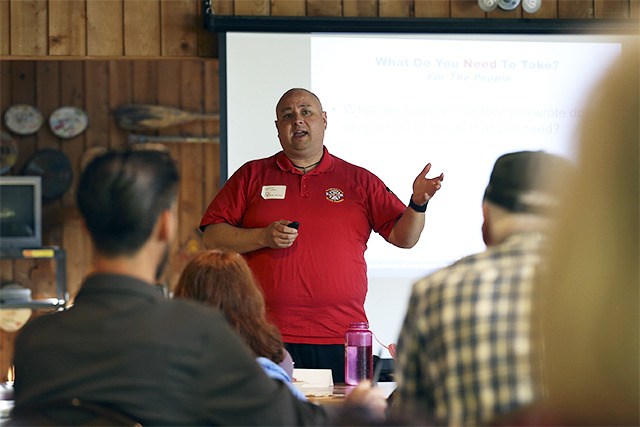
Bud Backer, deputy chief for Eastside Fire & Rescue, attended the free Firewise Leadership Conference and addressed the looming fire risk on Thursday, May 7, at Camp River Ranch, in Carnation.
“We would like to see (Firewise) expanded,” Backer detailed over the phone. “We were talking about how to get people concerned… We expect a more active fire season than normal due to the extended drying period (expected this summer).”
Backer said there’s a misconception that wildfires never occur in the Valley, but he said that’s because there are a lot of fire departments and resources out here, so they catch them quickly.
“Even if we have a ton of fire resources… eventually we’re going to be busy on one…” he warned.
Backer said Firewise provides more than just a fire preparedness, but encourages “communities preparing as a whole” to form evacuation routes, for example.
“When the fire department comes through and says ‘Run,’ you’ll have no time to grab photos or birth certificates,” he said.
One of the Firewise members who’s ready to run is Richard Werlein. He started the Lake Alice chapter after he said a burn ban, along with added disposal costs, removed the incentive for people to properly dispose of their yard waste.
“Throughout that process, we’ve become a lot tighter of a community,” Werlein stated during the conference. “It’s in our best interest to see our neighboring communities have a Firewise community, as well, and share resources.”
One community Werlein has his eye on is near Snoqualmie, where a field of elevated scotchbroom on the Ridge is a genuine fire-fear for his community.
“Fire is an integral part of our ecosystem. We just don’t to see it as often on the west side of the Cascades,” said Anthony Starkovich, south zone fire management officer for the U.S. Department of Agriculture, from his office in the National Forest Service station in North Bend.
“We have a lot more fuel in our forest,” he continued, though he said it’s predominantly waterlogged, which deters the fire from spreading.
Starkovich has worked for the forest service for 27 years and his fire unit covers as far north as the Glacier Peak Wilderness Area to the Mount Rainier National Park boundary in the south. “We stay pretty busy,” Starkovich quipped.
Starkovich said his department tip-toes along the delicate line between balancing controlled and naturally ignited fires in remote forests that healthily take their course, and making the decision to fight fires that might reach developed areas. He said his department is most aggressive with suppression in the mid-summer months, but it varies on a case-by-case basis.
To prepare for the fire season, the Mount Baker-Snoqualmie National Forest Service is taking on the usual, seasonal 17-person firefighter team. Behind the office building, there are two Type 3 engines, one smaller, patrol Type 6 truck.
The forest service also has a “mirror” force in the north zone, Mount Baker Ranger District, as well as the south zone at North Bend with the Snoqualmie Ranger District.
When asked about his fire-preparedness advice, Starkovich displayed the freshly cut vegetation, with shrubs reaching more than 18 inches away from the office building.

A view of the North Bend Forest Service office’s freshly trimmed shrubs for ultimate fire safety.
He stressed that personal fire suppression is key, especially after his department tackled roughly 30 human-caused fires last year from abandoned campfires gone awry.
“Number one, if you ignite any type of fire,” he continued, “make sure it’s extinguished completely before you leave it unattended.”
To start a Firewise branch visit www.firewise.org.
To learn about area burn bans, visit
https://fortress.wa.gov/dnr/firedanger/BurnRisk.aspx.
To contact the South Puget Sound dispatch, call (360) 825-1631.
To report a fire, dial 911.
Fire safety
The Washington State Department of Natural Resources (DNR) recommends a few basic, household practices to protect your communities:
• To protect your home from embers, clear leaves/debris from your lawn, gutters, eaves, porches, roofs and decks. Replace or repair shingles or roof tiles.
• Remove dead vegetation within 10 feet of the house or stored items from underneath decks and porches.
• Screen or box-in areas below patios and decks with wire mesh to prevent debris/combustible materials from accumulating.
• Store firewood, propane tanks and dry vegetation 30 feet away from your home’s foundation and outbuildings, including garages and sheds.
• Prune trees so the lowest branches are 6 to 10 feet from the ground.
• Keep your lawn hydrated and maintained, but cut it down if it’s brown.
• Cover exterior attic vents, under-eave and soffit vents with a metal wire mesh no larger than 1/8 inch to prevent sparks from infiltrating.